

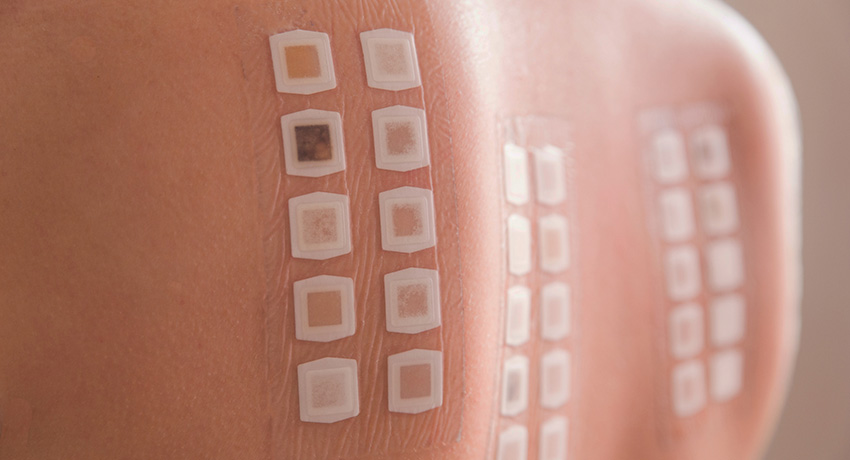
You’ve switched to fragrance-free products, gentle detergent, and a sensitive-skin moisturizer, but the rash won’t go away. Before you give up, a clinical test can identify exactly what your skin is reacting to, down to the chemical.

Skin patch testing, offered by specially trained dermatologists, diagnoses allergic contact dermatitis, a skin allergy triggered by direct contact with a specific substance. Just like poison ivy, the same type of reaction can happen with fragrances, preservatives, metals, dyes, adhesives, and other ingredients found in everyday products.
“A woman with a new facial or neck rash may not realize that her acrylic manicures are underlying the process,” said Megan Rogge, MD, a dermatologist at UT Physicians Dermatology – Bellaire Station. “Skin patch testing can help uncover these allergies.”
Unlike a typical allergic reaction, this one doesn’t happen right away. The rash usually appears a day or more after exposure, making it harder to connect to a specific trigger. It can look like eczema, which is why many people go months or even years without answers.
Understanding the testing process
Skin patch testing starts with a consultation to review rash history, patterns, and possible triggers. The process takes about a week and involves three visits:
- Monday: Small chambers are taped to the patient’s back, each containing a different allergen. No needles are involved. Most adults are tested with about 90 allergens—chemicals for which people in the U.S. are most commonly exposed. A smaller panel is available for children.
- Wednesday: The patches are removed, and a preliminary reading is done after 30 minutes.
- Friday: The dermatologist reviews each test site, grades any reactions, and explains the results: what allergens are positive, including where the allergen may appear in everyday products and what alternatives are safe.
Avoiding exposure
For people with allergic contact dermatitis, treatment focuses on avoidance rather than medication—find the trigger, eliminate exposure, and the skin often clears on its own.
“Rather than starting on a systemic drug to treat eczema, you can adjust the products you’re using and may not need medication,” Rogge said.
Despite their labels, products marketed as “hypoallergenic” or “fragrance-free” aren’t necessarily safe for everyone. They may avoid common irritants, but individual allergies vary and can occur to gentle ingredients.
Applying the results
Knowing your skin allergies is only part of the solution. The next step is figuring out where those ingredients are hiding. Allergens can go by multiple names, show up in unexpected products, and cross-react with similar substances. Even careful label reading doesn’t always tell the full story.
“Sometimes it becomes investigative work, which is part of what makes it fun,” said Rogge, an associate professor of dermatology at McGovern Medical School at UTHealth Houston. “It’s challenging, but it can make a real difference for the patient when you figure it out.”
Fortunately, tools are available to help. The American Contact Dermatitis Society developed a web-based resource (the Contact Allergen Management Program) that helps patients identify safe personal care products. This exclusive tool is available to society member physicians and their patients. A companion app allows users to scan product barcodes while shopping to see whether an item is safe based on their specific allergies.
While helpful, skin patch testing isn’t a catch-all allergy test. It won’t diagnose hives—which require testing by an allergist—or evaluate food allergies.
If you have a rash that hasn’t responded with treatment, follows a consistent pattern or location, or seems linked to an external exposure, it might be time to consider skin patch testing. Contact UT Physicians dermatology to schedule an appointment at 888-4UT-DOCS or visit utphysicians.com.