
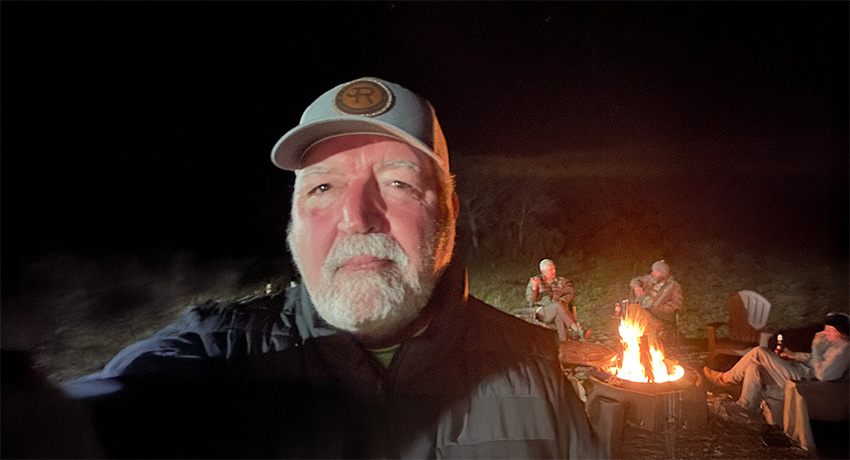
As a highly active 78-year-old, David Fish lives a full life. He not only works full time as an oil company executive but also enjoys hunting at a Texas Hill Country ranch. He realizes he’s lucky that a symptom he casually mentioned at the end of his UT Physicians primary care appointment was taken to heart. This “by the way” comment ultimately saved his life.
January 2024 kicked off as a normal year for David. He was healthy, took no medications, and celebrating more than 45 years at his oil and gas company. While at his ranch that month, however, David experienced two concerning symptoms. First, he began struggling to breathe, which he initially attributed to walking pneumonia from the cold weather. But it was the second symptom that proved most alarming, although he didn’t realize it at the time.
“I went totally blind in my left eye for about 30 minutes,” David said. “Rather than panic and run to Llano 17 miles away, I kept doing what I was doing. My sight came back completely within an hour, and that was that.”
A visit to an emergency clinic back in Houston for his breathing issues revealed his lungs were fine, but he needed to see a cardiologist. Within weeks, David had three coronary stents placed in his arteries for coronary artery disease.
The blindness incident, however, remained a footnote until September.
Listening to subtle symptoms
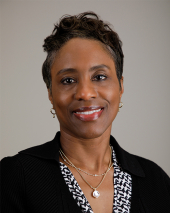
David continued to have shortness of breath, easy fatigue, and leg weakness – even after his coronary procedure. During a follow-up appointment with Carman H. Whiting, MD, a family medicine specialist at UT Physicians Multispecialty – Sienna, David casually mentioned his temporary vision loss nine months earlier.
“His symptoms were concerning for a vascular issue,” said Whiting, an associate professor of family medicine at McGovern Medical School at UTHealth Houston. “Anytime you have a vascular issue in the heart, you can have a vascular issue anywhere. The temporary vision loss made me wonder about blood flow to the area.”
Whiting, who has been David’s physician since 2016, said this type of casual mention is surprisingly common in primary care, occurring about 40%-50% of the time.
“It’s a ‘by the way’ comment with my hand on the doorknob and someone tells me they had chest pain or something,” Whiting said. “Patients commonly think of something at the last minute, which sometimes turns into something big.”
Connecting the medical dots
Whiting ordered a carotid duplex scan and leg ultrasounds for further exploration. Tests quickly revealed the severity of David’s condition: his left carotid artery was 99% blocked, and his right side was 90% blocked. These are the major blood vessels in the neck that supply blood to the brain.
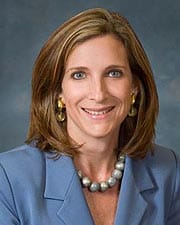
Whiting immediately referred David to Sheila M. Coogan, MD, a vascular surgeon at UT Physicians Heart & Vascular – Bellaire Station. With high blockage in both carotid arteries, David was a walking time bomb for a potentially massive stroke. He had no idea. His vision loss was a stroke symptom on his left side, but he was asymptomatic on the right side. David’s case was complex with cardiac and carotid issues occurring simultaneously.
Understanding risks of carotid artery disease
Approximately 34% of all strokes are attributed to carotid artery disease.
Coogan said the challenge with carotid artery disease is not being able to predict who will become symptomatic. In David’s example, the 99% stenosis on his left side had probably been there for a long time. Fortunately, he didn’t have an issue with plaque breaking off, blocking blood flow to the brain, and causing a stroke. For patients with symptoms, Coogan operates when there’s more than 50% stenosis because data suggests they would benefit from surgery.
But patients without symptoms have strokes, too. The risk is about 11% over five years, which averages to a 2% risk. For patients with stenosis greater than 70% and symptomless, Coogan said surgery is generally recommended because the long-term risk of stroke is lower with surgery than without. The risk from waiting is worse than the risk of surgery.
“For heart attack and stroke issues, we treat them preemptively because the consequence of missing something is so devastating and life-altering,” said Coogan, a professor of cardiothoracic and vascular surgery at McGovern Medical School at UTHealth Houston.
Moving to surgery
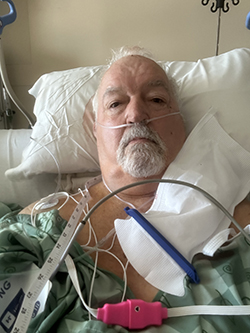
Coogan performed David’s first surgery in October 2024, a left carotid endarterectomy that opened the left artery and removed the blockage. This procedure is considered the gold standard for treating carotid arteries, though there are several treatment options based on the patient’s anatomy and preference.
The second procedure in March 2025 followed a newer stenting technique called transcarotid artery revascularization (TCAR). A tube is inserted into the carotid artery that temporarily directs blood flow away from the brain. A stent in the carotid artery opens up the narrowed artery like a spring and helps prevent future strokes.
As someone who values relationships, David appreciates the personal touch his medical team provided.
“I knew I was in excellent care,” he said.
Recovery and life after carotid artery procedures
True to his driven nature, David was back at work within a week of his first procedure. His recovery was smooth, with only minor numbness remaining on his left side.
“Dr. Coogan told me before we even started, ‘what I’m doing is preventing you from dying of a stroke,’” he said.
Coogan described David as an easy patient with a bigger-than-life personality.
“He’s always paying it forward, which is a nice gesture,” Coogan said. “It’s nice when a patient recognizes and acknowledges they’ve been getting good care.”
David’s third physician on his UT Physicians team is Simbo M. Chiadika, MD, a cardiologist at UT Physicians Multispecialty – Sienna and an associate professor of cardiology at McGovern Medical School at UTHealth Houston. Although Chiadika didn’t perform David’s cardiac procedure, he moved to her practice for his future cardiac care. He appreciates the collaboration between his doctors and the seamless sharing of medical information.
These days, David continues his active lifestyle, still working long days and planning to retire in one year. His advice to others is simple: Don’t ignore warning signs, even if they seem minor.
“All this slowed me down a little bit, but it hasn’t derailed me by any stretch of the imagination,” David said.
With proper screening, timely intervention, and access to quality care, people with severe vascular disease can maintain active, productive lives well into their later years. Most importantly, it shows how a simple “by the way” comment to a trusted doctor can save a life.