

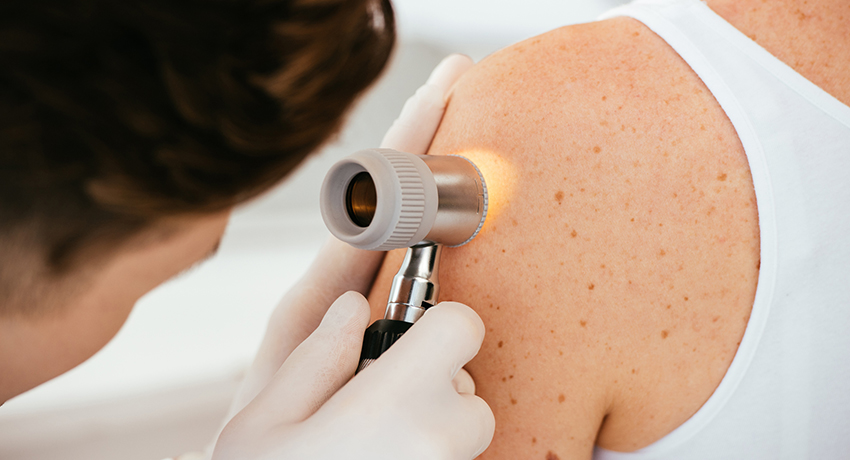

No one knows your skin better than you. Tracking changes in your skin is an important way to understand your risk for skin cancer. Empower yourself with this screening guide, the ABCDEs of skin cancer, to discern whether a mole warrants a dermatologist check.
“Most patients come in because they did a home skin check first. When you’re checking your own skin, you’re already staying aware of your health and helping identify problems early,” said Megan Rogge, MD, a dermatologist at UT Physicians Dermatology – Bellaire Station.
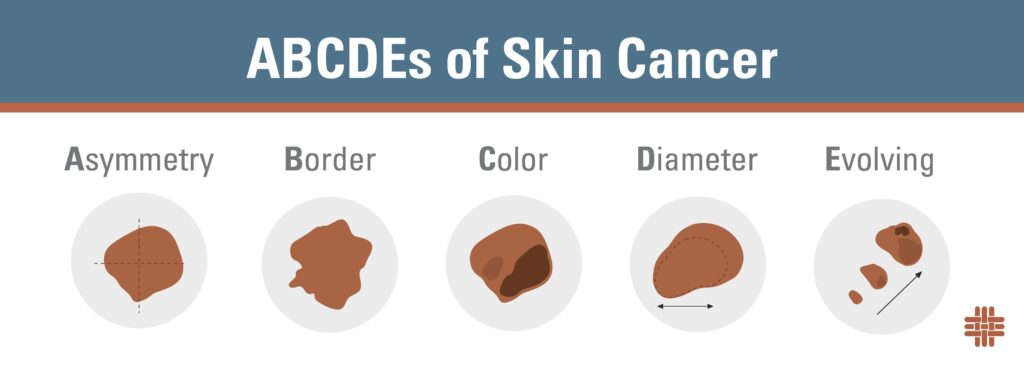
What are the ABCDEs of skin cancer?
The ABCDEs are a set of criteria to determine potential skin cancer, specifically melanoma, the most dangerous form of skin cancer.
They stand for:
A – Asymmetry: If you fold the lesion in half, the two sides should match up. If they do not, the mole is asymmetric. Asymmetry is a warning sign.
B – Border: Look for an irregular border. Does one portion of the border jut out? Or did one portion of the border lose pigment? An irregular border is a warning sign.
C – Color: All of the moles on your body should be about the same color. Look for noticeably different coloring, multiple colors, or loss of color. Odd coloring is a warning sign.
D – Diameter: A mole that is larger than the tip of a pencil eraser is concerning.
E – Evolving: If the mole is evolving or changing over time, this is a warning sign.
“We also like to know if there is pain associated with the mole,” said Rogge. “A swollen or irritated mole suggests something is not right.”
Common types of skin cancer
Skin cancer is a growth on the skin, divided broadly into melanoma and non-melanoma skin cancers.
Non-melanoma: This is the most common form of skin cancer diagnosed in the United States. Non-melanoma develops in the upper layers of the skin. Basal cell carcinoma and squamous cell carcinoma are the most common types of non-melanoma skin cancer. Non-melanoma will present as a pink, potentially scaly or firm bump on the skin. It is slow growing with subtle changes and commonly found on sun-exposed areas like the face and hands.
Melanoma: Diagnosed less frequently, this form of skin cancer is more serious and has a higher risk of spreading if not detected and treated early. Melanoma develops as a new lesion or from an existing mole and commonly has pigment or a brown color to it. It is most frequently found on areas that get intermittent high volumes of sun exposure, like lower legs and the back. Melanoma skin cancer can be fatal.
Skin cancer risk factors
Developing skin cancer is part genetics and part sun exposure.
“We know people who have a family history of skin cancer, people with fair skin, who freckle easily, and have 50 or more moles on their body have a strong genetic predisposition to developing skin cancer,” explained Rogge, an associate professor at McGovern Medical School at UTHealth Houston. “But personal sun exposure also impacts the risk.”
Every blistering sunburn increases the risk for skin cancer. Using a tanning bed, even just a single time, is associated with an increased risk for developing skin cancer.
Skin cancer prevention tips
While you can’t change your genetic risk factors for skin cancer, you can modify sun exposure.
Avoid direct sunlight during peak hours from 10 a.m. to 2 p.m. When outside, always wear sun-protective clothing or sunscreen with an SPF of 30 or greater and check the sunscreen label for broad-spectrum UV protection.
Seek shade when your shadow is shorter than you, as this means the sun is overhead and UV rays are strongest, putting you at the greatest risk for skin cancer.
When to see a dermatologist
A physician evaluation is always recommended when the body goes through unexpected changes.
“If you have a mole that qualifies for one of the ABCDE markers, get it checked by a board-certified dermatologist,” Rogge said.
Why the ABCDEs matter
Skin cancer, especially melanoma, can be deadly. Like most cancers, the earlier it is diagnosed and treated, the better the outcome. If a mole begins to look different than other moles on your body, use the screening tool and follow up with a dermatologist.