

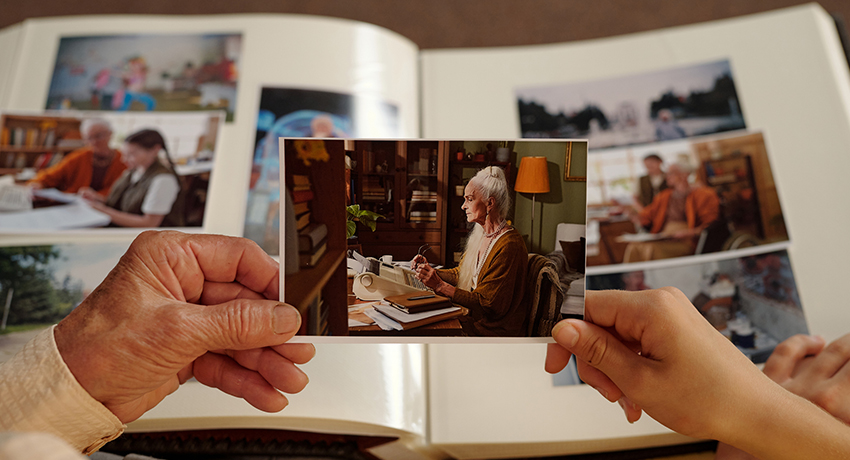
When short-term memory fades, the stories of a lifetime often remain. Experts are realizing these stories may be key to maintaining connection, identity, and cognitive health for people living with dementia. Finding ways to connect with a loved one who has Alzheimer’s or dementia can feel increasingly difficult as decline progresses. One powerful tool may be closer than many realize: storytelling.

According to Cristina C. Murdock, MD, a geriatric medicine specialist at UT Physicians Center for Healthy Aging – Bellaire Station, storytelling offers multiple benefits for people living with cognitive challenges.
“Storytelling can help maintain a sense of identity and self-esteem, encourage communication with caregivers, and facilitate meaningful engagement with others,” said Murdock, an associate professor of geriatric and palliative medicine in the Department of Internal Medicine at McGovern Medical School at UTHealth Houston. “Sometimes caregivers, family, and friends of those living with cognitive challenges may not know how to connect, and storytelling gives them an avenue to do this.”
The science behind storytelling
The benefits extend beyond simple conversation. When people listen to or share a story, their brain activates multiple areas simultaneously. They are processing words as well as triggering regions involved in images, emotions, and memories. This multisensory engagement helps listeners “experience” the story while their brain activity begins to mirror the speaker’s, creating a sense of connection. Research suggests this kind of engagement may help slow cognitive decline by keeping the brain active and building cognitive reserve.
“Regular storytelling provides mental stimulation that can help maintain thinking skills and build a reserve,” Murdock said. “This allows the brain to cope better with age-related changes.”
Studies also show that storytelling improves depressive symptoms in those with cognitive challenges.
When memories spark connection
Murdock has witnessed firsthand how storytelling can transform interactions between patients and their families. During one visit with a patient living with dementia, the patient’s daughter mentioned that her mother had worked as a seamstress.
“Suddenly, the patient’s face lit up as she described the decades she spent making wedding dresses, and the joy that work brought her,” Murdock said. “Storytelling supports not only caregivers and patients but also health care professionals by offering a deeper, more personal perspective of those we care for.”
This type of engagement, known as reminiscence therapy, works particularly well because it taps into long-term memories that often remain intact when short-term memory is impaired. Photos, music, or familiar objects can spark meaningful conversations by activating these deeper memory stores. In Alzheimer’s disease, short-term memory is typically affected first, which makes routine conversations difficult. Reminiscence provides structured emotional cues to encourage communication and increase social interactions.
Getting started at home
For families wanting to incorporate storytelling into their caregiving routines, Murdock’s straightforward advice is to just start! She suggests using prompts such as photos, music, familiar objects, or questions about earlier life to tap into long-term memory. Listeners are an important part of the storytelling process.
Murdock emphasized the goal isn’t historical accuracy but connection, engagement, and comfort. It’s OK if the details are mixed up.
Keep these tips in mind as you begin to use storytelling with your loved one:
- Listen more than you correct.
- Respond with curiosity and warmth.
- Keep sessions short and enjoyable to help with engagement.
- Remember that repetition is OK — hearing the same stories can feel reassuring and meaningful.
While storytelling won’t reverse dementia, it offers something equally valuable: moments of dignity, joy, and connection. The tools are already at hand, and the potential for meaningful connection is immediate.