
Breast cancer is one of the most prevalent cancers for women in the U.S., where 1 in 8 women will develop breast cancer in their lifetime. Screening is an important tool to fight this cancer because the chances of survival are highest when breast cancer is caught at an early stage.

The American College of Obstetricians and Gynecologists recommends breast cancer screening starting at age 40 for most women.
“Screening is a way to detect breast cancer early, making the cancer much more treatable,” said Cristina E. Perez, MD, an OB-GYN specialist at UT Physicians Women’s Center – Memorial City.
What type of breast cancer screening tests are available?
Breast cancer screening tests are used as an initial tool in patients with no symptoms. Here are imaging options for breast cancer screening:
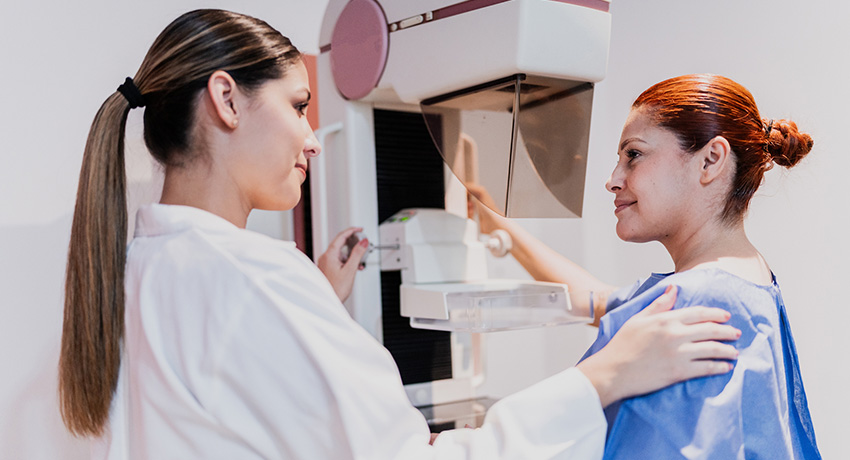
- 3D mammogram: The most common screening tool, a mammogram is an X-ray of the breast that can show masses, microcalcifications, and tissue architecture with low radiation exposure.
- Breast ultrasound: Used as a secondary screening, a breast ultrasound is recommended if a mammogram is inconclusive, shows an abnormality, or if the patient has dense breast tissue.
- Breast MRI: This is an additional secondary screening tool. Individuals who are considered high risk with a strong family history will typically have imaging every six months, alternating between a mammogram and breast MRI. A breast MRI is also recommended for patients with extremely dense breast tissue.
When to start mammograms?
Breast cancer screenings should be part of every woman’s annual care beginning at age 40, but family history and other risk factors can change that recommendation.
Mammograms before age 40
Discuss an early mammogram with your doctor if you have one or more of these increased risk factors:
- If a family member (mother, sister, aunt, or grandmother) had breast cancer, screening should begin 10 years younger than the affected relative’s age at diagnosis.
- If a patient is positive for the mutation in BRCA1 (BReast CAncer gene 1) or BRCA2 (BReast CAncer gene 2), screening starts at age 25.
- If a mass is found during a physical breast exam.
Mammograms for ages 40-49
- Women without an increased risk should begin mammogram screening at age 40.
- Screening should occur annually or every other year, depending on family history and level of risk.
Mammograms for ages 50-74
- Annual screenings are recommended.
- The median age for breast cancer diagnosis is 63, which makes screening consistency important to track changes after menopause.
Should women over 75 continue getting mammograms?
- If there is a life expectancy of 10 years or more, annual screening should continue.
- Patients should speak with their provider to understand the ability to benefit from treatment if cancer is found.
Tips for a more comfortable mammogram
Follow these tips to prepare for a better mammogram experience.
- Location: Find an imaging facility you can easily use each year, for consistency.
- Schedule: For pre-menopause women, avoid scheduling the week before your menstrual period, when breasts are swollen or tender.
- Clothing: Wear a top and bottom separates, so you only need to remove your top and bra.
- Jewelry: Don’t wear jewelry.
Why aren’t routine mammograms recommended for women younger than 40?
Breast cancer is most often diagnosed in women older than 40, which makes screening for women who are younger and living without increased risk factors less necessary. Younger women often have denser breast tissue, which makes screening less reliable, especially for women younger than 30.
Why are mammograms important?
Mammogram imaging can detect cancer before physical symptoms develop, making mammograms an important screening tool to find cancer early.
“Anytime we catch cancer early, there is a better chance of a successful outcome,” Perez said.
Breast cancer prevention starts at home with a healthy diet, regular exercise, reduced stress, and limited alcohol. At-home self-breast exams are an easy way to continuously check for breast lumps, and yearly mammogram screenings for patients 40 and older are vital, as this X-ray can detect tumors that can’t be felt.
“Screening at regular intervals is the best and most proactive activity a woman can take to prevent breast cancer or to find or detect any tissue abnormalities at the earliest possible stage,” Perez said.