

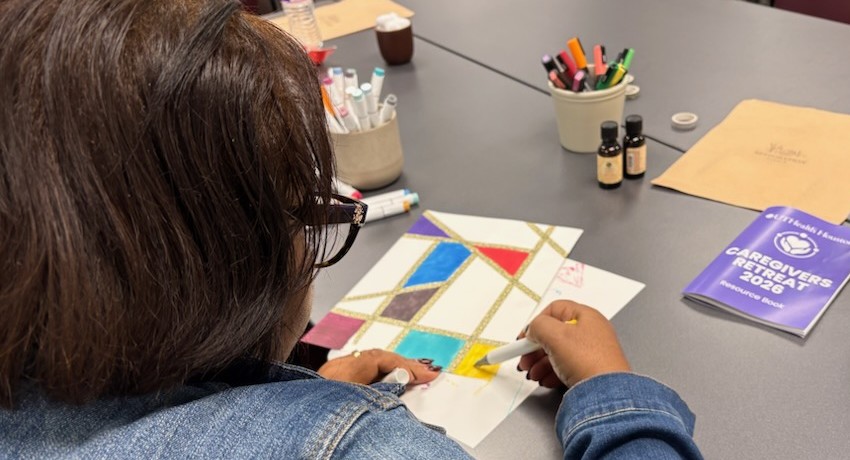
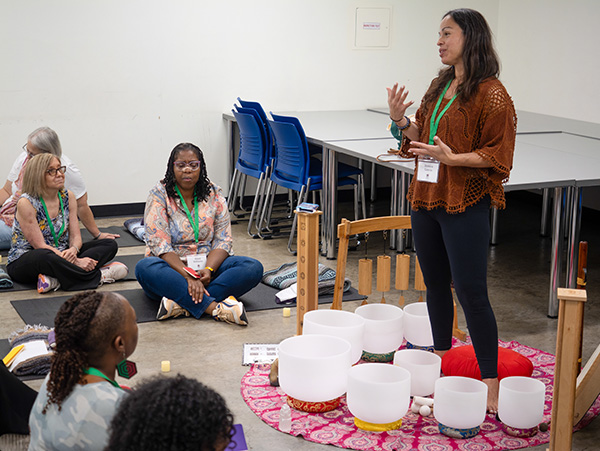
Paint pens, washi tape, and creative expression invited caregivers to set aside daily responsibilities and simply be present. Waves of resonant tones washed over participants in a sound bath, creating a rare opportunity to slow down, breathe deeply, and relax. Throughout the day, attendees found space for self-care, meaningful conversations, new connections, and valuable resources. For many, the retreat was a welcome reminder that caring for themselves is just as important as caring for others.
In its third year, the UTHealth Houston Caregiver Retreat has evolved as caregivers’ needs have changed. Retreat co-chairs Crystal L. Walter, LCSW, geriatric social worker at UT Physicians Center for Healthy Aging – Bellaire Station, and Cristina C. Murdock, MD, interim division director of the Joan and Stanford Alexander Division of Geriatric and Palliative Medicine at McGovern Medical School at UTHealth Houston, intentionally expanded beyond traditional caregiver topics and adjusted the format to focus more on caregivers’ mental health.
Addressing caregiving as a public health issue
New retreat themes addressed caregiver intimacy and relationship challenges, the financial burden, grief and bereavement after loss, and sharing opportunities in care circles. What began as a vision with no funding in 2024 has blossomed into an at-capacity event with a waitlist, returning sponsors, community partners, and 20 UTHealth Houston resident and employee volunteers.
Even as programming has expanded, the retreat’s central philosophy remains unchanged: Reframing self-care from luxury to habit is essential, because caregivers matter, too.
“Caregiving is a public health issue that deserves attention,” Walter said. “The retreat honors the caregivers who make sacrifices every day, as well as those who made the ultimate sacrifice–an expected death caused by a lack of support and self-care.”
The stats are astonishing around caregiver needs and burnout. It’s estimated that 70% of caregivers over the age of 70 will die before their loved one. Walter said for many of their patients, they never imagined the patient would outlive their caregiver.
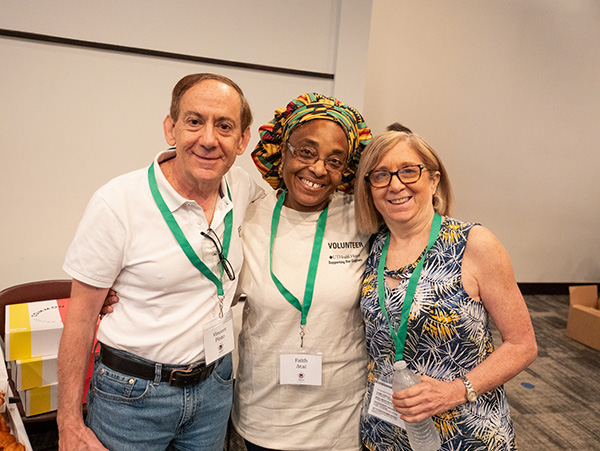
The presence of additional organizational leadership underscored the importance of supporting caregivers. They included Faith D. Atai, MD, and Maureen S. Beck, DNP, co-medical directors of UT Physicians Center for Healthy Aging – Bellaire Station.
Recognizing the needs of male caregivers
One encouraging trend is the growing number of male caregivers seeking support. In 2025, the number of men attending the caregiver retreat could be counted on one hand. This year, it doubled—and accounted for roughly 15% of attendees. As a result, Walter said they intentionally built programming around them, creating a men’s care circle as a break-out session. The goal was to create a space where male caregivers could feel comfortable discussing challenges that may differ from those of women.
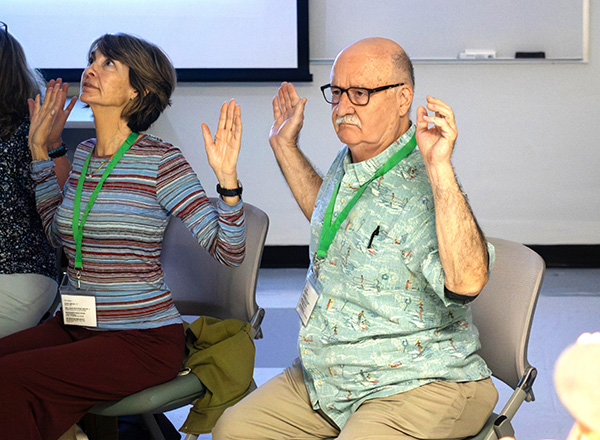
Richard Orellana came to the retreat to learn more. For years, he served as primary caregiver for his parents, who were both diagnosed with Alzheimer’s in 2019. Today, his care focuses on his mother after his dad passed in 2022.
“My journey with my mom is different than with my dad, so I’m looking for anything helpful to allow me to better care for my mom,” Orellana said. “Sometimes it’s taking time for ourselves. If I’m able to recharge, I’m better able to care for my mom.”
As his mother’s needs evolve, Orellana is mindful of the day she may need help bathing and how to provide that care while maintaining her privacy and dignity. Being around other caregivers is a big part of Orellana’s interest in the retreat.
“You can get resources from webinars, which is helpful and convenient, but sometimes just conversations with fellow caregivers are really helpful to have that connection,” he said.
Helping caregivers reclaim themselves
Another new aspect of this year’s retreat addressed how caregivers can discover their lost sense of identity after dedicating so much time caregiving for someone else. A panel shared insights on this perspective.
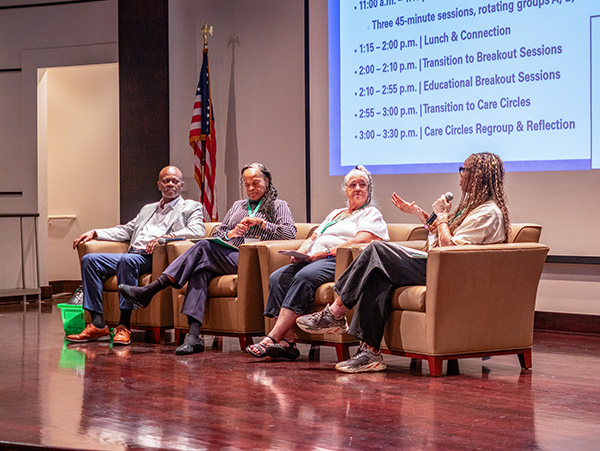
“As repeat attendees return, many are now navigating life after caregiving, experiencing grief and identity loss after the death of a loved one,” Walter said. “The retreat serves not only active caregivers but also those in a new phase of life.”
For Diann Valentine, 76, who spoke on the panel, life is a whole new world after her husband passed two years ago. She doesn’t ever regret taking care of her mother and husband. During her 41-year marriage, her mom lived with Valentine and her husband for 40 years. Later, she became caregiver for her quadriplegic husband with terminal cancer.
“I’m on a different journey now and back to being me,” Valentine said. “I’m doing everything I want to do again.”
Part of that journey is taking on a new name (Di) and moving to the mountains. Her advice is to be flexible, patient, and persistent.
Navigating family dynamics
Throughout the day, caregivers expressed a range of emotions connected to caregiving within their family. Some had the strong support of siblings or children, while others felt isolated and resentful. Although there is no right way, the conversations provided ideas for others or a safe space to vent.
For Karen Hays, the system to support caregiving for her 96-year-old mother includes Hays, her three sisters, and two paid helpers. Their solution is a monthly caregiving schedule for the six individuals, a syllabus with videos showing how to safely do tasks, and one sister who focuses completely on nutrition.
“You have to be solution-oriented for yourself, too,” Hays said. “I will just declare what I need. Otherwise, people think you’re strong and don’t need it.”
Jennifer Wong lives with her parents in their 80s as a full-time caregiver—a mother bed-ridden for the past year after experiencing two strokes and living with Alzheimer’s. She attended the retreat to access resources. In the process, she found a powerful outlet in the care circles. Her group shared what they brought to the day.
“I brought frustration, because I have a sibling, but she doesn’t help,” Wong said. “I guess I was seeking a little bit of justification being with others in the same boat.”
For Ann Friedman, PhD, keynote speaker and underwriter of the retreat through her family’s foundation since its first year, caregiving offered the most exhausting, horrific, tender, loving moments of her life.
“It’s a both/and, and I wouldn’t trade those moments for anything,” Friedman said. “But you must put your own mask on first.”