
An astronaut returning from months in orbit and a patient getting up after weeks of bed rest face a surprisingly similar challenge: a heart and body that have adjusted to doing less. Spaceflight offers a unique environment for studying problems that take years to develop on the ground, and the findings are reaching patients at UT Physicians and beyond.
“Space is the most extreme case of remote medicine,” said Kris R. Lehnhardt, MD, professor of emergency medicine and director of the Space Medicine Program at McGovern Medical School at UTHealth Houston. “If we can solve medical problems there, we can solve them anywhere.”
Echocardiograms and remote medicine
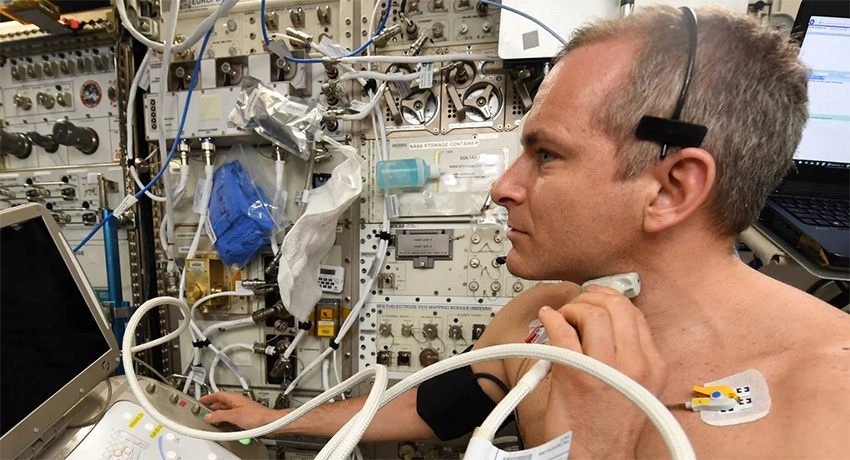
Michael W. Bungo, MD, professor of cardiology in the Department of Internal Medicine at McGovern Medical School, has seen that exchange first hand. In 1985, Bungo and his team captured the first ultrasound images of the human heart in space, offering new insights into how the body adapts beyond Earth. That portable machine, compact for its generation, has evolved into a laptop-sized ultrasound used in emergency rooms and other healthcare environments.
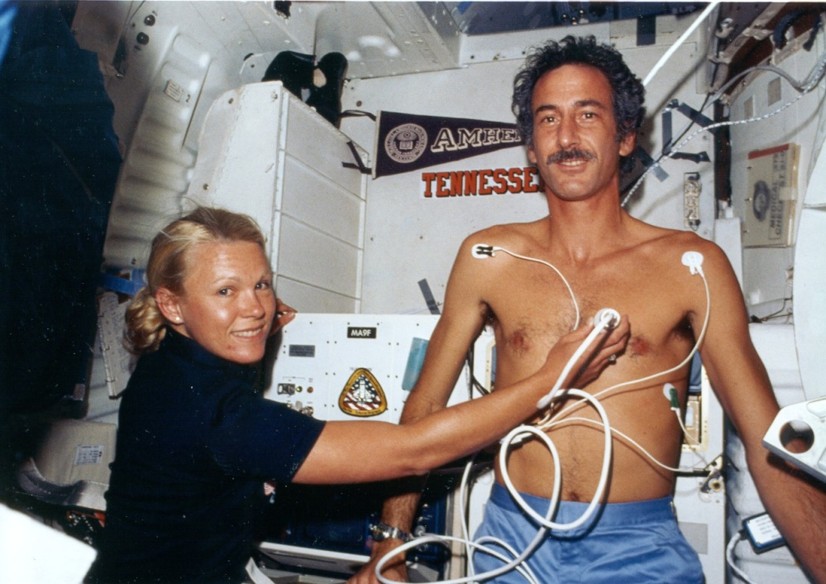
Before that flight, NASA took echocardiograms on the ground before launch and after landing. The historical moment not only proved that astronauts lose blood volume and that the heart shrinks in space but also revealed the possibilities of remote medicine.
“Astronauts learned to perform the scans on their own, which showed we could minimally, but effectively, train someone to get diagnostic or even research-quality studies,” Bungo said.
This research without a physician on board the spacecraft solved a similar challenge that exists for patients living in a rural town, on a ship, at a remote worksite, or in a disaster zone.
This solution will continue in the future on deep-space missions to Mars, Lehnhardt said. Communication delays of up to 20 minutes each way mean astronauts must be prepared to assess and treat medical problems independently.
Physiological changes and bone loss
The research also led to a broader understanding of how the body responds when gravity is no longer a factor.
“When people are on bed rest on Earth, their cardiovascular system deconditions, just like the astronauts in space,” Bungo said. “The research being done to understand that in space is directly applicable on Earth.”
In response, astronauts follow strict exercise routines in space to fight muscle, heart, and bone loss in their weightless environment. In the same way, Bungo said researchers on Earth use the buoyancy of aquatic exercise for patients, to see if a spaceflight model improves rehabilitation.
Because bone loss in space occurs over months rather than years—up to 3% bone loss per month—spaceflight offers researchers a faster way to study osteoporosis and its treatment. They are also studying how radiation and isolation affect aging, immunity, and behavioral health in space, findings that may inform care on Earth.
Space medicine at the university
UTHealth Houston’s connection to space dates to its founding. Charles Berry, MD, MPH, the first president of the university, known as The University of Texas Health Science Center at Houston at the time, served as NASA’s chief physician during the Apollo program.
For more than 20 years, the university has trained astronauts in basic emergency procedures, including suturing, treating fractures, starting IVs, and drawing blood, in the emergency department and the medical school’s simulation labs.
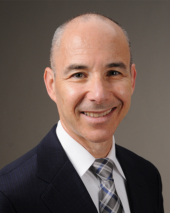
Today, the Department of Emergency Medicine leads a Space Medicine Program that includes a partnership with SpaceX and a fellowship for physicians entering the specialty.
Bentley J. Bobrow, MD, vice president of Healthcare Innovation at UTHealth Houston, said the greatest advances come when people challenge what is familiar and explore new frontiers. He believes UTHealth Houston has an opportunity to boldly go where science has not gone before.
“Not simply to explore space but to bring discoveries back to Earth where they can change lives and perhaps one day save a child’s life,” Bobrow said. “That possibility is what motivates us. That is the future we want to build at UTHealth Houston.”