UT Physicians provides primary and specialty care for patients of all ages. We have over 2,000 health care providers with expertise in more than 80 specialties and subspecialties. From routine visits to advanced services, our physicians practice at more than 100 locations across the Greater Houston area. Find the care you need and schedule an appointment with us today.
With more than 2,000 clinicians certified in more than 80 medical specialties and subspecialties, UT Physicians provides multispecialty care for the entire family.
A high-risk pregnancy, life-saving team, and miracle baby for Fetal Center employees
A high-risk pregnancy, life-saving team, and miracle baby for Fetal Center employees
Written By: Vicki Powers, UT Physicians | Updated: September 25, 2025
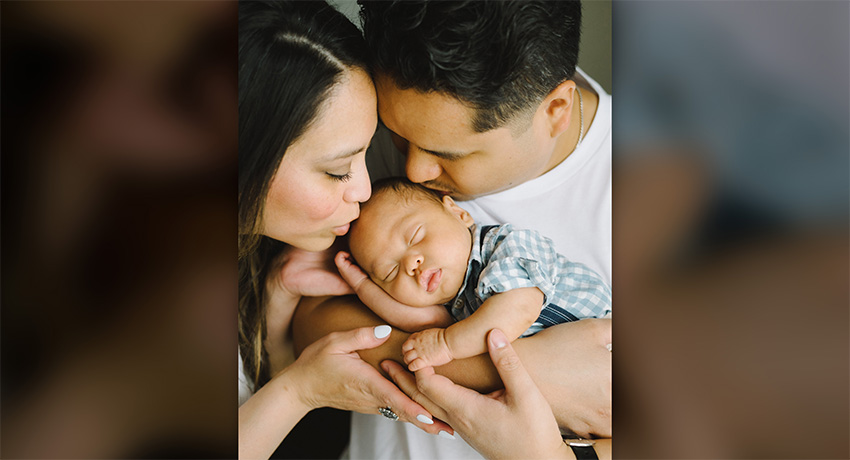
Karl and Tania Clarete, nurses at UTHealth Houston Fetal Center, credit the entire staff for their collaborative care and miracle baby. (Photo provided by family)
The most compelling patient stories sometimes unfold within our own walls. UTHealth Houston Fetal Center employees Karl and Tania Clarete had resigned themselves to life without children after years of trying and two miscarriages. But when an unexpected high-risk pregnancy developed in 2024, they experienced their workplace from a different perspective — as patients receiving care from colleagues who knew them best.
When Tania discovered she was pregnant at age 37, the couple’s emotions were complex. Their journey through fertility struggles had taught them to temper excitement with realistic expectations. By working at The Fetal Center, they understood the potential complications that could arise with Tania as a senior research nurse and Karl as one of the nurse coordinators for high-risk patients. This medical knowledge would prove to be both a blessing and a challenge throughout their pregnancy journey.
“We were excited and then scared and nervous, but more excited and hopeful,” Tania said.
Detecting early complications
At 10 weeks, Tania was informed her pregnancy was considered high-risk and the couple turned to their colleagues at The Fetal Center for an immediate evaluation.
At 19 weeks during a routine anatomy ultrasound, doctors discovered Tania’s cervix had shortened significantly, from more than 3 centimeters to 1.7 centimeters. Anything less than 3 centimeters increases the risk of preterm birth. The diagnosis meant Tania needed an emergency cerclage, a procedure to stitch the cervix closed to prevent premature labor. The risks were significant.
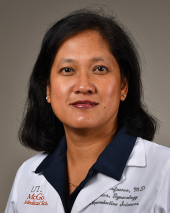
Jerrie S. Refuerzo, MD
“Two things happen when women go into labor: their cervix will shorten up and any activity within the uterus will make them dilate,” said Jerrie S. Refuerzo, MD, a maternal-fetal medicine specialist at The Fetal Center and professor of obstetrics, gynecology, and reproductive sciences at McGovern Medical School at UTHealth Houston. “Once we see that first part happening, our awareness increases that this patient might be at significant risk for preterm labor and preterm birth.”
Tania said she started crying because she didn’t want to lose the baby.
“We’ve been waiting this long, and it was the furthest I’d gotten in any of my pregnancies,” Tania said. “They told me, ‘If you do nothing, you are going to lose him.’”
Sean C. Blackwell, MD, chief of OB-GYN at McGovern Medical School, performed the emergency cerclage the same day.
Following the cerclage, Tania was placed on modified bed rest for the remainder of her pregnancy. Working remotely from home and supported by understanding colleagues, she was determined to give their baby the best chance.
Making an early arrival
At 31 weeks, Tania began experiencing contractions and was admitted to the hospital. After two days of monitoring, her water broke. During the delivery process, Tania developed a fever indicating an infection of the amniotic fluid and membranes. This serious condition required immediate delivery.
Within 24 hours, Tania developed acute respiratory distress syndrome (ARDS) as the infection spread to her lungs. She had an extremely difficult time breathing. At first, she thought she was pushing too hard but then realized it wasn’t normal.
“Tania would have her oxygen mask on, relax all her muscles, and then put all her effort and strength into the next push, when it was time,” Refuerzo said. “She’s a true example of the strength women have when having a baby. When they have a focus on their family and baby, they can overcome so many things.”
Providing calm, supportive expertise
Refuerzo maintained a calm, encouraging presence during the challenging delivery. Her ability to project confidence while managing the crisis behind the scenes was crucial and compelling for Tania.
“If she hadn’t been calm, supportive, and encouraging, I don’t know if I would have been able to do what I did,” Tania said. “Dr. Refuerzo would just look at me and say, ‘You’re doing great. I need you to focus. You need to get him out.’”
Refuerzo emphasized the danger of maternal sepsis as a potentially life-threatening condition. Tania declined so rapidly that Refuerzo said she was prepared to make the delivery room an ICU room. She had both anesthesia and the ICU on backup.
“If you looked outside her room in the hallway, they were ready for her,” Refuerzo said. “The minute that little Karl was born, we immediately activated everything for her health. They really helped save her life.”
Navigating a dual intensive care stay
Baby Karl weighed 4 pounds, 2.3 ounces at birth. Both he and Tania faced serious health challenges. Tania stayed in the ICU for three days, and baby Karl was in the neonatal intensive care unit (NICU) for nine weeks.
After having a rough start, baby Karl faced typical premature baby challenges — learning to breathe independently, maintaining his weight, and coordinating how to suck, swallow, and breathe while feeding.
Karl lived the challenge with his wife and baby in different intensive care units, but knew he had to stay positive.
You could tell that he had a purpose: to make sure his wife was OK and that his baby was OK.
Jerrie S. Refuerzo, MD – maternal-fetal medicine specialist
“My goal was to stay positive and to manifest that they’re both going to be OK,” Karl said. “But, of course, there’s that sense of uncertainty, also.”
Refuerzo said Karl displayed a true testament to being an amazing husband and father, literally going from ICU to NICU, back and forth, for several days.
“You could tell that he had a purpose: to make sure his wife was OK and that his baby was OK,” Refuerzo said. “I know it must have taken an emotional toll on him, but you would have never guessed by how he displayed himself.”
Tania found motivation through her son. With little Karl in the NICU, she said it pushed her to be a stronger person. She had to reach her own personal health milestones to be able to see him.
Appreciating collaborative care
The NICU staff, many of whom Tania had worked alongside in her previous role as a NICU nurse, couldn’t promise what would happen, but they did everything they could to achieve the best possible outcome. The staff listened, cared for baby Karl, and provided daily updates — all while helping build Karl and Tania’s confidence through a difficult time. Although not easy, Tania followed the advice from one of the neonatologists to “take your nurse hat off and put your mama hat on.” Both parents were at the hospital every day until baby Karl’s discharge nine weeks later.
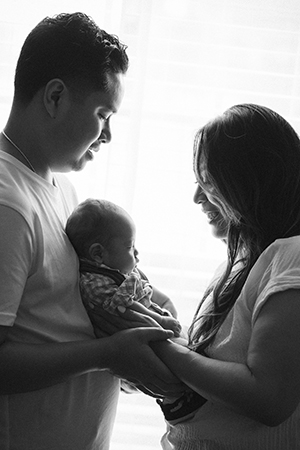
Karl and Tania describe baby Karl as strong, loving, and intuitive. He’s thriving at home after nine weeks in the NICU. (Photo provided by family)
“One day the light bulb turned on and it just happened,” Tania said about the moment Karl mastered feeding. It was something she’d seen countless times as a NICU nurse but experienced differently as a parent.
The couple credits the entire team at The Fetal Center for their comprehensive care. Having colleagues who knew their history and provided both professional expertise and personal support made an enormous difference. Additional members of Tania’s care team included Ramesha Papanna, MD, MPH, co-director of UTHealth Houston Fetal Center; Anthony Johnson, DO, a maternal-fetal medicine specialist at UT Physicians and co-director of UTHealth Houston Fetal Center; and Sami Backley, MD, a maternal-fetal medicine specialist at UT Physicians. All are faculty members with McGovern Medical School.
“If it wasn’t for them, I don’t know if my son or I would be here today,” Tania said. “All the physicians continue to check up on little Karl and me.”
Smiling at their family’s future
Now thriving at home, baby Karl is meeting his developmental milestones and even achieving some ahead of schedule. This progress gives Karl and Tania every reason for optimism about the future they fought so hard to achieve. They describe their son as strong, intuitive, and loving.
“I think the word that most describes him is strong, especially the journey that he went through. He has been through more than most of us have been through in his first few weeks of life,” Karl said.
The pregnancy challenges gave Tania and Karl deeper empathy for the families they serve professionally. In the past, Karl felt sympathy, but now he feels empathetic.
As the clinical practice of McGovern Medical School at UTHealth Houston, UT Physicians has locations across the Greater Houston area to serve the community. To schedule an appointment, call 888-4UT-DOCS.