

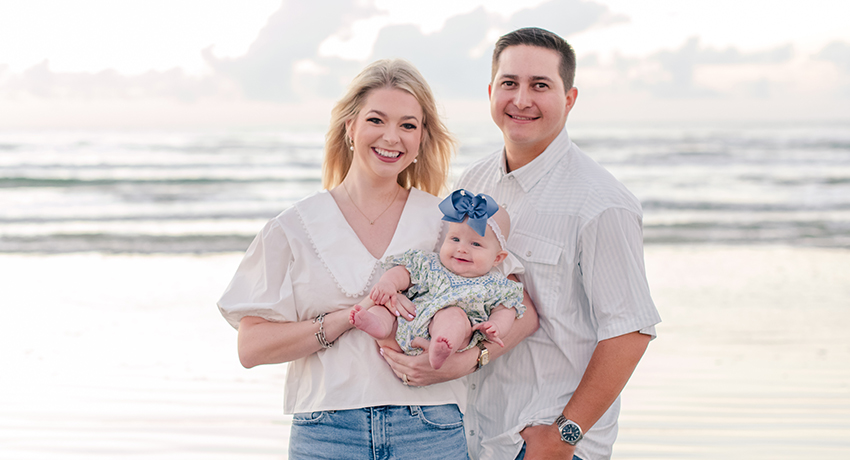
As first-time parents-to-be, Kacie and Drew Gonzales found themselves facing unthinkable news — hearing their baby might not survive after delivery. While they were initially overwhelmed, the couple leaned on two things: their unwavering faith and a dedicated team of maternal-fetal medicine specialists at the UTHealth Houston Fetal Center. Today, they call their daughter a miracle.

“I always say one day Rylan’s going to have a big testimony to tell, because God has a plan for her,” Kacie said.
Learning the reality
Kacie, a physician assistant in College Station, Texas, experienced a difficult pregnancy from the beginning with severe hyperemesis — uncontrollable nausea and vomiting — and pancreatitis. Then, the 20-week anatomy scan brought more concerning news: her baby had severe fetal growth restriction and low amniotic fluid. This condition occurs when the fetus measures small (less than the 10th percentile) for its gestational age. But in Kacie’s case, her fetus was less than the first percentile. While it’s a common high-risk condition, it does require attention and expertise to monitor the fetus for growth.
Kacie’s OB-GYN immediately referred her to specialists in Houston, who then directed the couple to an even more specialized team. That’s where they met Anthony Johnson, DO, co-director of the UTHealth Houston Fetal Center, maternal-fetal medicine specialist, and professor of obstetrics, gynecology and reproductive sciences at McGovern Medical School at UTHealth Houston.

Johnson explained to the couple that a small fetus could indicate one of three things: it could be small because the parents are also petite, and that’s not a concern, or it could be the placenta isn’t working well enough to provide all the nutrients the developing baby needs to grow to full potential.
“A third reason could be something happened at conception,” Johnson said. “Is it a biologically normal variant without major impact or an underlying genetic disorder with a long-term impact? That’s the one we’re constantly dabbling in to see what’s happening in that context.”
Kacie said she’ll never forget the meeting they had with Johnson after the prenatal ultrasound.
“We went in a meeting room, and Dr. Johnson started writing on the whiteboard and explained things in detail. It was really helpful and scary at the same time,” Kacie said. “But it gave us hope to get some answers and have a plan in place.”
Transferring to specialty care
At this point, the team decided that it would be safest for Kacie’s baby to be monitored closely in Houston and transfer her prenatal care to the Maternal Care Program at The Fetal Center. Johnson introduced the couple to Rachel A. Newman, MD, MBA, a maternal-fetal medicine specialist, who partnered with Kacie and Drew during their pregnancy.

Newman described the first step in making the parents’ concerns seem manageable. She worked to retrain Kacie’s thought pattern away from self-blame, which is common in this situation for moms-to-be. She, as well as the dedicated team of Fetal Center physician assistants and nurse practitioners, also took the time to ensure Kacie and Drew knew that not only was their daughter being cared for, but also that they were using the same collaborative approach to her care.
Newman said the strength of The Fetal Center is that it easily facilitates this kind of teamwork, which requires regular communication with multiple subspecialists and a willingness to work with each other to adapt the plan as needed.
Living in the hospital
As the amniotic fluid surrounding her baby continued to dwindle without clear cause, at 28 weeks Kacie was admitted to the hospital. She ultimately wouldn’t leave for more than two months. Johnson said increasing surveillance reduced the likelihood they might miss something and ultimately lead to a bad outcome.
Drew moved in with her, sleeping on an air mattress beside her bed every night.
“When you’re in the hospital for that long, you have to find some joy in it, or you’ll lose your mind,” Kacie said. “We’d go on little dates in the hospital, like to the different cafeterias to try out the different chocolate cakes.”
They decorated their room for the holidays, brought in goodies for the doctors and nurses, and celebrated making it through another week every Friday. The hospital was their temporary home, and they laughed and called it their “little apartment.”
But beneath the brave face, the fear was ever-present. Their baby was so tiny that Kacie could barely feel her move. Sometimes she felt a kick or a flutter, but it was difficult to know if she was OK.
Supporting through uncertainty
A reality of medicine often becomes supporting families through uncertainty.
“A lot of obstetrics requires patience and a willingness to live in this gray space where we don’t know exactly what’s going on,” Newman said. “We pay attention to the cues that both the mom and fetus are giving us.”
Each week, they looked at the baby via ultrasound, and sometimes twice a week, when needed. Kacie and Drew wanted to get to 35 weeks as the goal for delivery, giving the baby more time inside her.
“When we’re dealing with that proverbial black box of not knowing the right answer, you make your best guess,” Johnson said. “We were very open with them: ‘This is what I know and don’t know. This is what we can keep doing.’”
Leaning on faith
Through the darkest days, Kacie and Drew turned to their faith.
“Every night we’d pray over our baby that she would grow and that my fluid would be stable,” Kacie said. “We’d read the Psalms every day in the Bible. I truly believe that she is a miracle, because she’ s doing so well now.”
Drew found strength through conversations with their local priest, as he supported Kacie at the same time.
“The scariest part were the unknowns,” Drew said. “To this day, we still don’t know why we had to go through that.”
A team that became family
The medical team surrounding them became like family, and they felt like they were Johnson’s only case.
“He would come check on us after clinic, because some days I’d be really anxious,” Kacie said. “He would sit down on the chair and just talk to us. Dr. Johnson always had a plan in place and the biggest heart.”
Newman provided calm reassurance through frightening moments.
“There was one night where Rylan’s monitor kept dipping,” Kacie said. “Dr. Newman came in the room and sat on the bed next to me. She put her hand on me and said, ‘It’s going to be OK, Kacie.’ She was just so calming. I truly believe God called her to be our OB for a reason.”
The miracle arrives
At 34 weeks and three days, the team determined it was time to deliver — so close to their goal of 35 weeks. Their baby’s growth had flatlined, and continuing the pregnancy posed too great a risk. During the C-section, Newman lowered the curtain so Kacie could see her daughter as she held her up. The 2-pound baby they expected actually weighed 4 pounds. Kacie said she looked huge!
While Kacie was still on the operating table, Johnson was already upstairs in the NICU checking on her baby, texting Kacie pictures with reassurance that everything was OK.
“How amazing to have your OB sewing you up and your high-risk doctor up in the NICU checking on your baby for you,” Kacie said.

During Rylan’s delivery, a worship playlist filled the delivery room. The anesthesiologist captured the moment: The song playing was “Don’t Stop Praying.”
“It still just gives me chills,” Kacie said. “It’s a true testament.”
Coming home
Against all odds, baby Rylan needed no respiratory support despite her early arrival. After just eight days in the NICU — when they had mentally prepared for two months — the family heard they could go home. It sounded too good to be true.
At six months old, Rylan weighs over 13 pounds and is hitting all her developmental milestones. Kacie said although Rylan is petite, it’s hard to know what she went through.
Kacie, who has taken time off from work to be a full-time mom, stays in touch with the medical team, sending updates and pictures. She is thankful for additional care team members who took care of her: Jimmy Espinoza, MD; Jerrie Refuerzo, MD; Suzanne Lopez, MD; Drew Sikes; NP, Christine Serewis-Pond, PA; and nurse navigator Sandra Uribe, as well as all the advanced practice providers and nurses.
“We’re glad we were there,” Kacie said, of their extended hospital stay. “It was quite the journey, but we’re on the other side.”
For this family, Rylan will always be more than just a healthy baby. She’s living proof that sometimes miracles happen when faith meets exceptional medical care.