

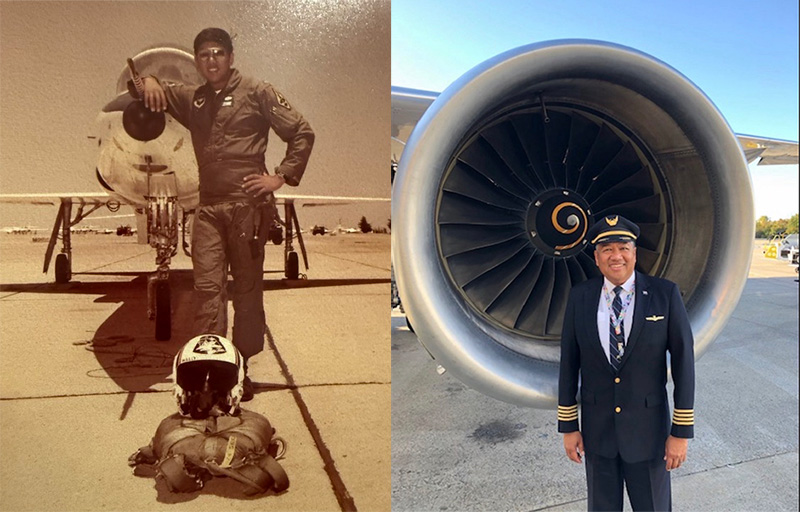
Wally Zane loves flying planes. With a career spanning nearly 50 years, first in the U.S. Air Force and then with a commercial airline, he grew accustomed to the often-busy schedule of a pilot’s life.
“It was eat what you can, when you can,” Wally said.
He didn’t notice a change in how he enjoyed food until he retired.
“I wasn’t able to eat food as quickly or in the quantities that I could before,” Wally said. “I started to feel like the food just wouldn’t go down.”
After years of trying to find a fix, from food allergy testing to acid reflux medications, he was no closer to answers until he was referred to Teminioluwa A. Ajayi, MD, a gastroenterologist with UT Physicians Gastroenterology – Northeast.
When symptoms are impossible to ignore
Wally’s symptoms worsened gradually over several years. He could swallow, but food would stall in his esophagus instead of passing into his stomach. What felt like food caught in his throat was actually food filling up in his esophagus. He was able to eat only a small amount of food at each meal, regardless of what he ate. And eventually he would have to excuse himself from a meal, sometimes multiple times.
“I would feel it building up, and I would have to go to the bathroom and throw it up,” Wally said.
By the time he found Ajayi, he was burping up undigested food and had developed a persistent cough.
“Turns out I was regurgitating food in my sleep that was getting trapped in my lungs,” Wally said. “I had no idea.”
Ajayi diagnosed Wally with Type 2 achalasia, a swallowing disorder.
What is achalasia?
Achalasia is a rare disorder that affects esophageal muscles. In an average adult, the esophagus is a 9- to 10-inch-long tube of muscle that moves food and liquid into the stomach. In people with achalasia, those muscle nerves are damaged and do not push food and liquid into the stomach. At the same time, the lower esophageal sphincter doesn’t open to let food into the stomach.

Symptoms often include a feeling of food or drink getting stuck in the throat, regurgitation of swallowed food, heartburn, chest pain, belching, coughing at night, unintended weight loss, and vomiting.
Left untreated, achalasia increases the risk of cavities, foul odor in the mouth, and pneumonia from food getting into the lungs, which can be life-threatening.
There is no known definitive cause of achalasia. It can affect people of all ages but is most common in adults 30 to 60 years old.
“The most common complaint from patients is that they can’t finish a meal, or it takes them one to two hours of chewing to eat their meal,” Ajayi said. “Often, by the time they come to see me, they have switched to a liquid diet, which can greatly impact quality of life.”
Diagnosis for achalasia
UT Physicians offers comprehensive testing to diagnose achalasia.
“Our comprehensive approach helps us narrow down the particular disease phenotype driving symptoms,” Ajayi said. “When we know all the symptoms and have results from a range of specialized tests, we can offer personalized treatment. We are not just treating a number on a test.”
Barium swallow: The patient swallows contrast during an X-ray. This shows how narrow the esophagus is.
Endoscopy: A thin tube with a camera is inserted through the mouth to examine the esophagus and stomach. The camera can see abnormalities such as tumors and a narrow esophagus.
Esophageal manometry: A test to measure the strength of the esophageal muscles and changes in pressure as the patient swallows. It also measures the tightness of the lower esophageal sphincter.
Ambulatory pH impedance test: A test to measure the amount of acid refluxed from the stomach into the esophagus.
Types of achalasia
There are three types of achalasia.
“Defining which type a patient has gives us a clue into the duration and severity of their disease and helps guide how aggressive to be with therapy and what to expect,” Ajayi explained.
Type 1: Esophageal muscles barely contract. Food and beverages move down through gravity alone.
Type 2: The most diagnosed form of achalasia. Pressure builds up in the esophagus, causing it to narrow.
Type 3: The most severe form of achalasia. The esophageal muscles contract sporadically, especially at the bottom of the esophagus, where it meets the stomach. The contractions can cause severe chest pain.
Specialized treatment for achalasia
There are several options for achalasia treatment, depending on the patient’s symptoms.
In Wally’s case, Ajayi recommended a minimally invasive procedure called peroral endoscopic myotomy, commonly called the POEM procedure. It is endoscopic; no incisions are made on the outside of the body. During this highly specialized and technical procedure, the gastroenterologist makes a small incision in the lower esophagus.
“It almost seems as though we were never there,” Ajayi said. “It’s a minimally invasive procedure that is quite effective for achalasia.”
The patient is placed under general anesthesia. The procedure lasts on average one to two hours, followed by an overnight stay at the hospital for observation.

Recovery from POEM procedure
Wally was on a liquid diet for two days after the procedure, followed by two weeks of soft food, and no travel for three weeks.
“I felt good right from the get-go,” Wally said. “I didn’t need any pain medication. I honestly didn’t feel bad at all.”
Before achalasia treatment, Wally was on daily acid reflux medication. Since completing the POEM procedure, he has been weaning off. He takes the acid reflux medicine only when needed.
“He has done very well in his recovery,” Ajayi said.
Reclaiming mealtimes
Six months after leaving the hospital, Wally has regained enjoyment for food. Eating normally again allows him to continue pursuing his passion for aviation by volunteering with the Civil Air Patrol.
“Without a doubt, Dr. Ajayi improved my quality of life,” Wally said. “From day one, he cared deeply, and he was very personable and upfront. He’s meticulous in everything he does, and he does it in a kind way.”
Achalasia is a rare disease, which means diagnosis can be difficult. Some people may spend years searching for answers and face a list of incorrect diagnoses for food disorders or allergies. At UT Physicians Gastroenterology, each patient’s case is personalized with a care team that takes time to thoroughly review symptoms.
“I want patients to know that their symptoms are valid, and they don’t have to suffer,” Ajayi said. “We have a trusted team relying on extensive research and clinical evidence, working with the tools and infrastructure to narrow down a diagnosis and offer a range of treatments.” “This was a partnership,” Wally said. “He looked at my case individually with a goal of getting me back to normal and off medications. Everything was first rate, and everyone was very caring.”