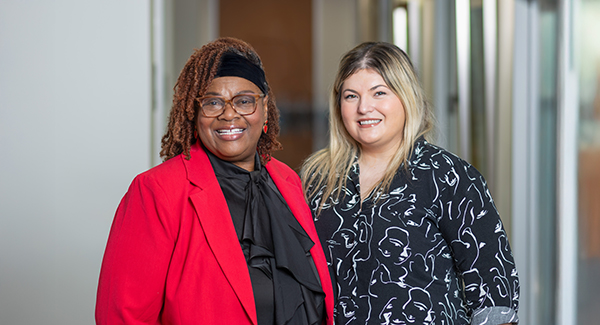


Reclined with a bag of snacks, a bucket of popcorn, her laptop, and movies, Lakenya Perry-Allen, EdD, prepares for another day-long chemotherapy treatment.
“I create an experience for myself when I’m in that chair. I set up like I’m at the movies,” Lakenya said. “It’s mind over matter.”
Movies may get her through the day, but for this director of STEM education at Stafford Municipal School District, it’s her students who keep her pushing through the 18-week chemo treatment course.
“I love, absolutely love changing kids’ lives. This is what keeps me fighting,” Lakenya said.
Education is not a job, it’s her life. After receiving her uterine cancer diagnosis, the former teacher of the year had one thing on her mind.
“The first thing I asked was, ‘Can I still go to work?’” Lakenya said.
Endometrial cancer

Lakenya was referred to Ioana L. Bondre, MD, MPH, a gynecologic oncologist with UT Physicians, after endometrial cancer was discovered in her uterus during a medical procedure.
The official diagnosis: uterine carcinosarcoma, a subtype of endometrial cancer that is rare and aggressive.
Endometrial cancer is a type of cancer that develops in the endometrium, the inner lining of the uterus.
“There are multiple subtypes, and uterine carcinosarcoma is known to spread quickly to other areas of the body,” explained Bondre, an assistant professor of obstetrics, gynecology, and reproductive sciences at McGovern Medical School with UTHealth Houston.
Because it spreads quickly, uterine carcinosarcoma is more likely to be diagnosed at an advanced stage. Fortunately, Lakenya’s case was caught in an early stage, likely because she was paying close attention to subtle changes in her body.
Symptoms of endometrial cancer
The most common symptom of endometrial cancer is the unexpected onset of bleeding, often heavy and irregular, symptoms that can be easily confused with menstruation.
Lakenya, who was 52 at the time of diagnosis, initially attributed her symptoms to menopause.
“I knew my body was changing. What I thought was spotting between periods was actually a sign of cancer,” Lakenya said.
Most endometrial cancers are found early because of symptoms like postmenopausal bleeding.
“In postmenopausal women, any type of bleeding, whether heavy or light, should be investigated,” said Bondre. “This could be hiding a cancer.”
Additional symptoms also include pelvic pain, cramping, bloating, and weight loss.
Risk factors for endometrial cancer
In the United States, endometrial cancer is the most common cancer of the female reproductive organs. Most cases are diagnosed in women 50 years and older, meaning it largely impacts post-menopausal women. African American women are impacted more than other ethnicities.
The biggest risk factor for developing endometrial cancer is having an excess of estrogen in the body.
Risk factors that increase estrogen levels include:
- Obesity and eating a high-fat diet
- Having a period early in life (before age 12) and going through menopause later in life
- Taking an estrogen hormonal replacement therapy without progesterone
- Never having been pregnant
Taking Tamoxifen, a breast cancer medication, can also increase the risk of developing uterine cancer.
The most important modifiable risk factor for all endometrial cancers is obesity, as excess estrogen is produced in fatty tissue. It’s always a good idea to maintain a healthy weight and reduce the use of hormone replacement medications to lower the general risk for endometrial cancer.
The majority of uterine cancers do not have a genetic component.
“Uterine cancers are common and can cluster in families, but it’s likely related to lifestyle and environmental factors, and not genetic,” Bondre explained.
Surgical treatment for endometrial cancer
Bondre’s first step to determine treatment was a round of CT scans of Lakenya’s chest, abdomen, and pelvis.
“I was looking for signs the cancer spread, but we were able to catch this while it was still a stage one,” she said.
Lakenya underwent minimally invasive surgery within weeks of her cancer diagnosis. The uterus, cervix, fallopian tubes, and ovaries were removed through several small incisions around the belly button.
“This is the standard of care now for uterine cancers,” Bondre said. “These are common organs where the cancer can spread, and we have to remove them and have them evaluated at the microscopic level. Then we create a plan for post-surgery treatment.”
Bondre also performed pelvic lymph node biopsies during the surgery for an additional check of cancer spread.
Preventive chemotherapy treatment for endometrial cancer
The rate of recurrence for uterine carcinosarcoma is 50%.
Due to the aggressive nature of this subtype of endometrial cancer, Bondre recommended chemotherapy treatment as a preventive measure.
“We want to decrease the chance of recurrence,” Bondre said. “It only takes one cell to metastasize somewhere else in the body for recurrence to happen.”
Lakenya began six cycles of chemotherapy.
“The experience is so organized and easy. They make me feel like I’m going in for a spa day instead of chemotherapy,” Lakenya laughed. “They schedule my labs, doctor’s appointment, and chemo treatment back-to-back to minimize the time spent away from my work.”
Common side effects of chemotherapy treatment include fatigue, nausea, vomiting, and reduced immunity.
Lakenya has experienced neuropathy, which is nerve damage that can lead to tingling or numbness in the hands and feet, and she also has hair loss.
“I’ve noticed my hair is thinning, and for me, that’s the emotional side of it,” Lakenya said. “I am proud of my hair. It’s one of my attributes.”
When her chemotherapy treatment ends, her hair will grow back, and she will be under surveillance and be seen every three months for the first two years.
Hope ahead
Lakenya is expected to recover well.
“There are many reasons to be hopeful in Lakenya’s case,” Bondre said. “She sought care early, leading to an early diagnosis, treatment, and limited chemotherapy.”
For women who often prioritize the care of others over their own care, Bondre says the message is to prioritize their own health.
“These cancers are highly treatable, even the aggressive subtypes, but all of the treatments work much better with a higher chance of cure if we find the cancer early,” Bondre explained.
Operating in love
Finding care with Bondre was like finding care with a family member for Lakenya.
“She operates in love,” Lakenya said. “Her bedside manner is stellar. I’ll never forget when she told me she was treating me like she would treat her own mother, and I believed her. I wasn’t scared of the diagnosis. I was scared of not being able to work.”
Eager to get back to sharing STEM education throughout her district, Lakenya found the prompt care she needed at UT Physicians to remove an aggressive cancer and the treatment plan to fit her recovery and career.