
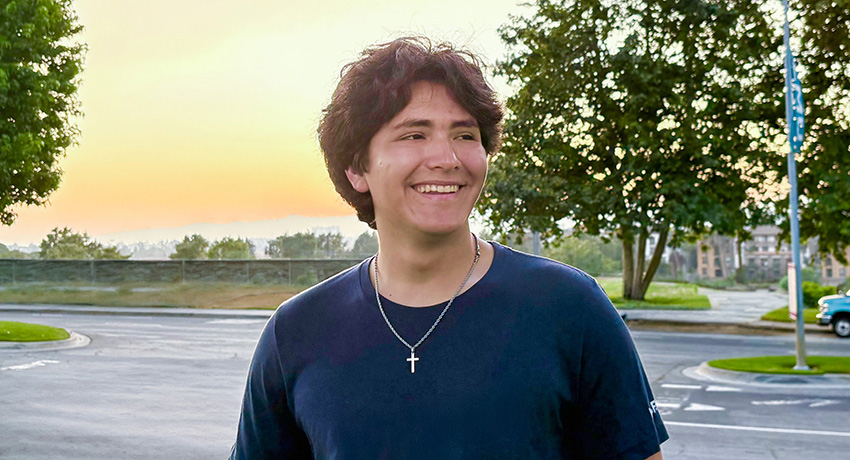
In high school, Aidan Chaidez couldn’t run short stints without pain. Today, he’s crossed a half-marathon finish line. The turning point came when he chose an uncommon path to get there—one that began with a surgeon intentionally breaking and rebuilding his legs.
Aidan’s leg pain began in elementary school. At 7, he had his first procedure to address uneven bone growth. Surgeons placed a screw in his right femur to slow its growth and allow the left to catch up. What was expected to take about three months stretched into a year.
Even after surgery, his family noticed increasing curvature in his legs, and the pain began to limit his activities in high school. Aidan knew it was time to see another doctor.
After a year of referrals, Aidan connected with Lindsay M. Crawford, MD, an orthopedic surgeon at UT Physicians Pediatric Orthopedics – Bellaire, who specializes in limb deformities. Through X-rays, Crawford discovered Aidan’s problem was not limited to his femur, but also a misalignment of his feet. His shinbones, the tibia on each leg, had two separate problems: a bowing and a rotation.
“These issues caused a mismatch between the thigh bone and the shinbone at the knee,” said Crawford, also an associate professor in orthopedic surgery at McGovern Medical School at UTHealth Houston. “That misalignment was the source of his chronic knee pain. Without treatment, it would only get worse.”
Breaking the bone to fix it
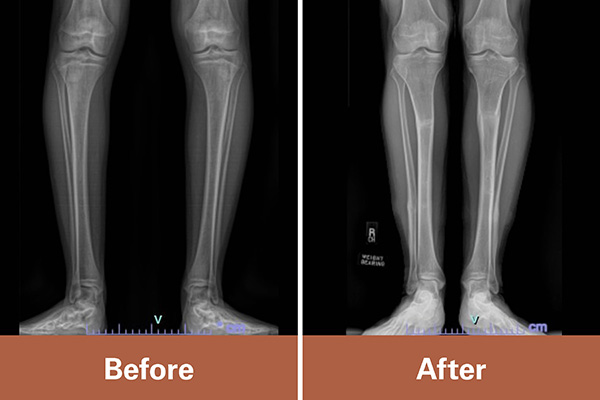
Crawford outlined two treatment options with the family. One would correct the alignment in a single procedure using a rod. The second option would gradually correct the deformity over time. Aidan and his family chose the slower approach.
The procedure—a bilateral tibial and fibular osteotomy with gradual deformity correction—involves cutting the lower leg bones and attaching an external frame with rings and adjustable struts. Over six weeks, the device slowly moves the bones into proper alignment.
Aidan admitted he was nervous about the surgery.
“I knew it would be a big surgery and take a lot of time to recover,” he said. “But I also knew it would help me in the long run, so I was ready.”
Crawford admits this procedure, done on each leg separately, requires a commitment from the patient and family. She showed them the metal frame in clinic, so they could look at it, feel it, and get an idea of how heavy it is before moving forward with the surgery.
“We support patients mentally and emotionally, because it’s tough to have the frame on for four months,” she said.
Round one of surgery
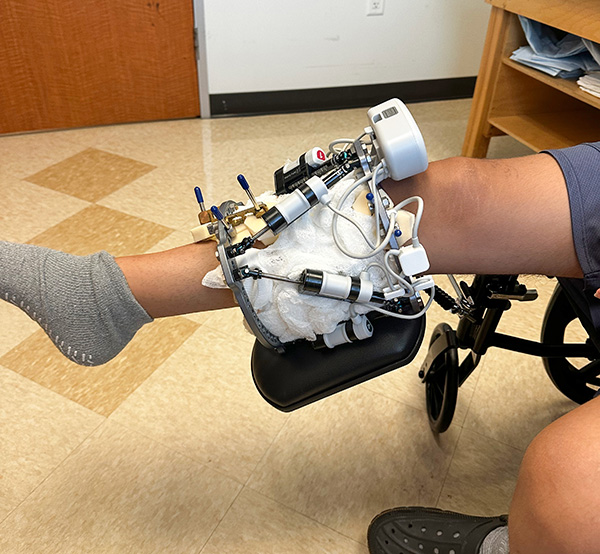
Crawford performed the first surgery on Aidan’s right leg in August 2023. Following the surgery, he wore the external metal frame for four months, which slowly corrected the bowing and stabilized it to heal.
In detailed precision, a computer guided the adjustments, calculating exactly how much each strut needed to move. Each day, Aidan or a family member followed a printed schedule, ensuring the struts were moving by the prescribed amount.
“We move it a millimeter a day,” Crawford said. “That gives us room to keep things moving safely without going too fast, while also allowing the bone to maintain a connection so it can heal back together. It’s actually a very cool concept!”
One of the biggest advantages of this approach is its ability to adjust in real time. During follow-up visits, Crawford adjusted the rotation based on how Aidan’s foot felt and how it appeared on imaging.
Navigating recovery
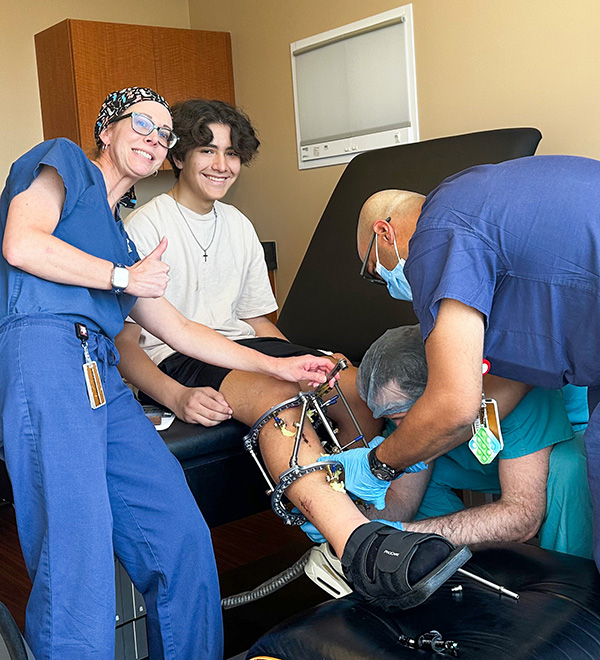
The four months with the external frame were challenging. Aidan spent the first month in a wheelchair, then moved to crutches before gradually bearing weight. He also navigated a spread-out high school on crutches and no formal accommodations. Despite that, Aidan maintained strong academic performance.
“The most challenging part was not being able to walk and having to depend on everyone for basically anything,” Aidan said. “I didn’t like my mobility taken away for all that time.”
Daily care added another layer. Aidan spent 30 minutes to an hour cleaning the pin sites (the spots where the frame’s metal rods entered his skin) to prevent infection.
Aidan completed physical therapy for two months after the frame was removed to rebuild muscle and regain flexibility.
Gearing up for a second surgery
Aidan was not looking forward to a repeat surgery on his second leg. As a result, he postponed it by a few months until June 2024 to take a break.
“My main motivation was knowing this would eventually help,” Aidan said. “When I pushed the date back, I was more ready.”
Crawford was impressed with his determination.
“It showed a lot of resiliency on Aidan’s part to undergo not one, but two, complex surgeries with external frames,” she said.
Both surgeries ran into complications that extended recovery. After slipping in the rain, Aidan re-fractured the healing bone, adding weeks to his timeline. After the second surgery, he developed a skin reaction that required a week-long hospital stay.
The full recovery from surgery, frames, wheelchair, boot, and crutches took an average of nine months for each leg. Despite the additional complication with his second surgery, Aidan didn’t need physical therapy, because he maintained better muscle strength with consistent exercise before surgery.
Reaching the finish line
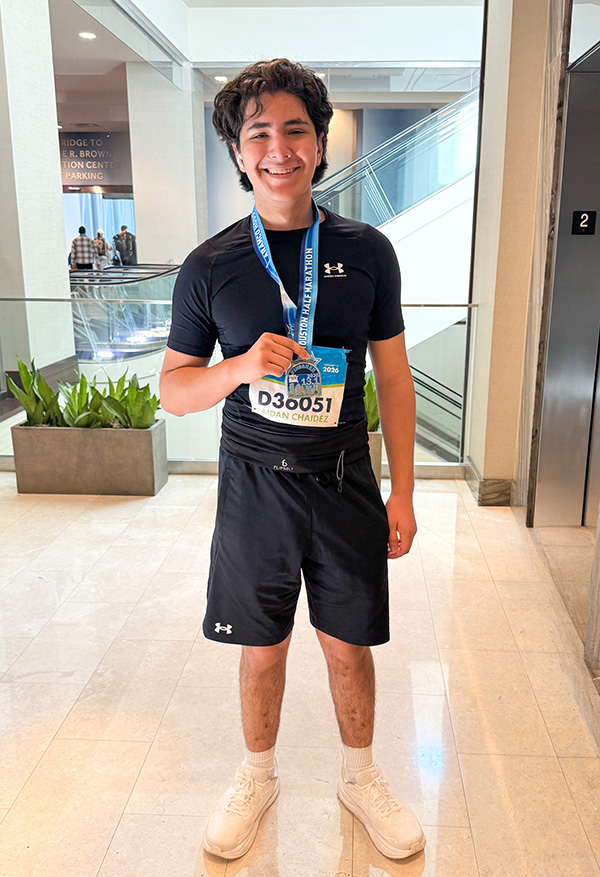
By spring 2025, Aidan had recovered from both procedures. Before surgery, running hadn’t felt realistic. His goal was simply to walk without pain. Yet, he started running, just a mile at first and then two, steadily working toward a goal he set during the hardest moments of recovery.
“I set a goal to run a half-marathon after both my legs were recovered,” Aidan said. “That goal kept me going.”
In January 2026, Aidan crossed the finish line. That milestone helped him feel fully recovered.
Looking back, he’s most proud he went through the surgeries despite the physical and mental toll.
“There were times when I was wondering why I did this, regretting the decision,” he said. “But now I’m thankful. Before surgery, I felt pain in my bones, and now I don’t.”