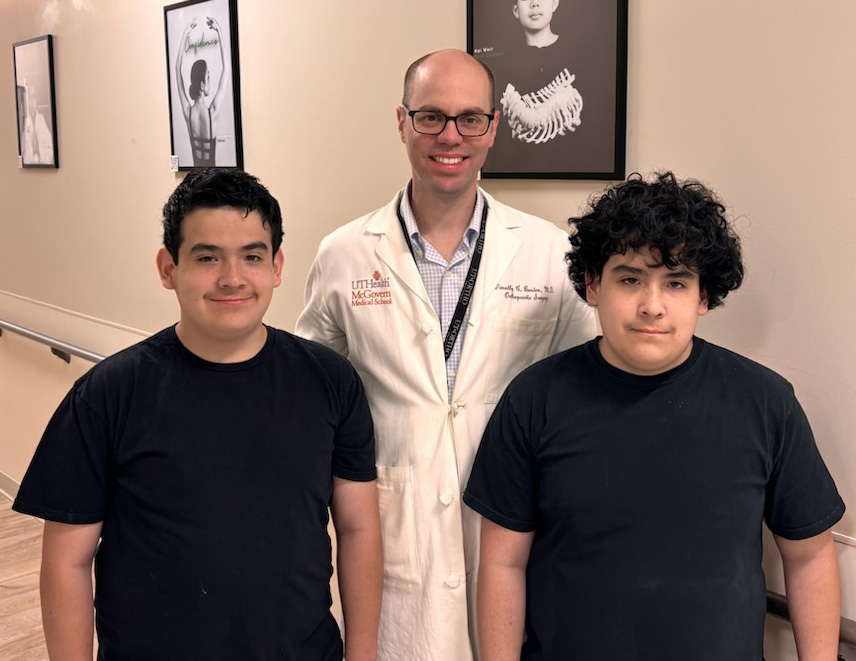
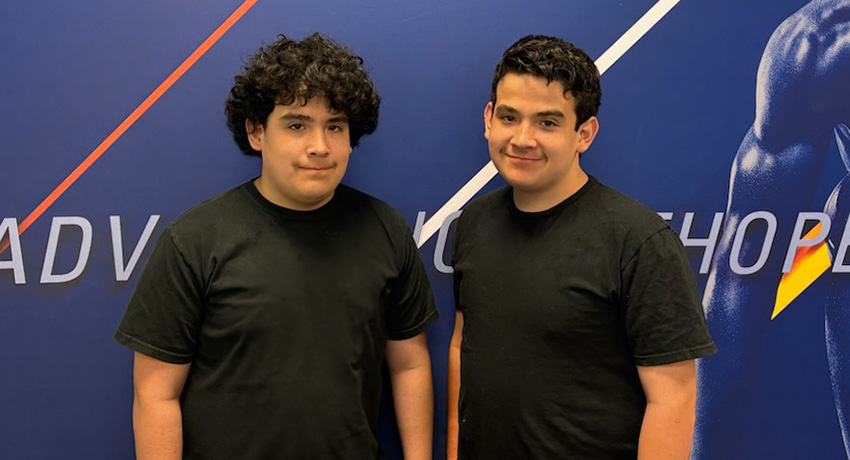
For twin brothers Brandon and Bradley Gonzales, now 15, friendly competition has always been part of growing up, even when it came to recovering from spine surgery. Born at 28 weeks, both were later diagnosed with scoliosis, a curvature of the spine severe enough to require surgery. While scoliosis surgery is uncommon, it is even more unusual for both twins to need the procedure. With treatment from a UT Physicians pediatric orthopedic surgeon, the brothers are now back to the activities they enjoy.
In early 2023, their mother, Susie Gonzales, started noticing small things about Brandon—how he got tired faster than others on family outings and needed to stop and rest. He also complained that his back hurt when sitting and leaning forward to do work at school.
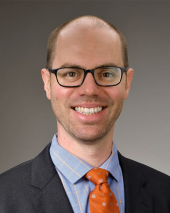
An answer came during a routine pediatric checkup before the school year began. His pediatrician performed a scoliosis screening, ordered X-rays, and advised the family to see Timothy C. Borden, MD, a pediatric orthopedic surgeon at UT Physicians Pediatric Orthopedics – Bellaire, right away.
Brandon, who is deaf and communicates primarily through American Sign Language (ASL), had a curve that measured more than 50 degrees at his first appointment with Borden. The surgeon talked through treatment options with the family. They monitored the curve for several months, but it continued to increase.
The diagnosis scared Susie, because it was an unknown for her. She went home and researched everything she could find. She hoped surgery could wait until summer break, but Borden’s timeline moved much faster due to the severity of Brandon’s curve.
“I was concerned that if we didn’t move to correct the curvature of his spine, it was only going to get bigger and create a larger problem for him,” said Borden, assistant professor of orthopedic surgery at McGovern Medical School at UTHealth Houston. “He still had a fair amount of growth left.”
Planning for the first scoliosis surgery
Borden recommended a selective thoracic fusion to address Brandon’s largest spinal curve while preserving as much motion as possible in his lower back. Brandon’s biggest curve was in his thoracic spine, the middle part of his chest and torso.
“By addressing the big curve in the middle of his spine, we were able to continue to preserve his lower lumbar motion and keep that lower curve as small as we could,” Borden said. “That curve has been stable and not required any additional surgeries.”
Borden’s team built a custom communication plan around Brandon’s needs, coordinating with the scoliosis program’s patient advocate and nurse navigator so ASL interpreters were on hand for every critical moment. A tablet-based interpreting service was also available around the clock to help Brandon communicate with his care team when family members were not present.
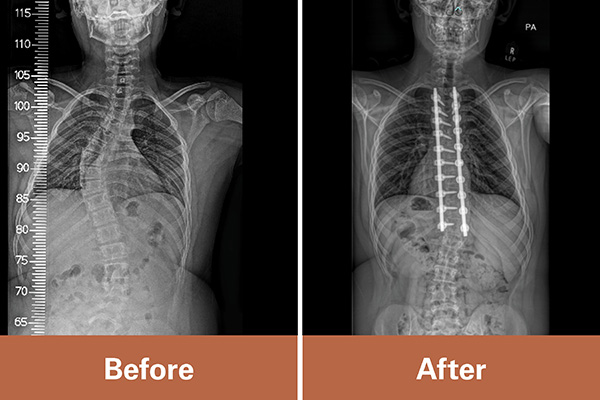
In January 2024, Borden completed Brandon’s surgery by placing screws into the spine and using rods through an incision in the back to straighten the spine. Borden said scoliosis is a three-dimensional curvature, so they use different techniques to correct all three planes of deformity.
After surgery, Susie was concerned when Brandon was slow to wake up from anesthesia. Bradley came in and kissed him, which he hates, and he woke up—a moment she made sure to photograph, knowing the brothers would laugh about it later.
Asked about the hardest aspect of his scoliosis journey, Brandon replied with a simple answer: “It was hard for mom.”
Within a few months, Brandon was back to swimming, playing basketball, running, and spending time outdoors. He was even asking to ride mechanical bulls again before he was officially cleared.
“Don’t worry, just take your medicine,” said Brandon, regarding his advice to other young patients facing the same surgery.
Discovering a second scoliosis diagnosis
Not long after, Bradley visited Borden for his own spine evaluation. Bradley’s biggest challenge was discomfort while gaming, as a result of sitting for extended periods of time.
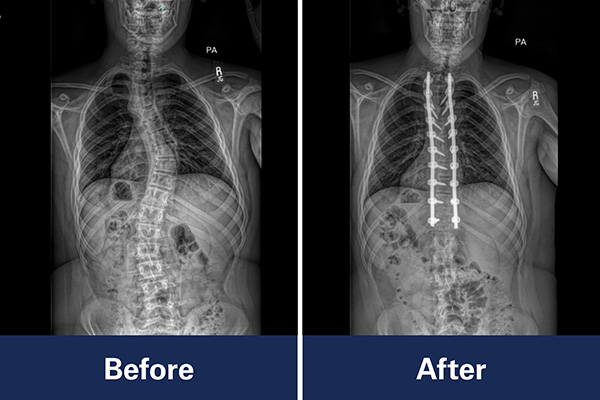
Bradley also was diagnosed with scoliosis, though his curve measured about 40 degrees. His treatment began with a scoliosis brace, worn mostly at home and overnight, for about a year to try to limit his curve progression. Bradley described it as difficult and uncomfortable, and he frequently wanted to take it off, like many teens.
Unfortunately, his curve increased to more than 56 degrees despite the bracing. The family talked through treatment options with Borden, since Bradley still had growth remaining. Once spinal curves reach the high 50-degree range, surgery is often recommended, Borden said. Bradley’s next step was spine surgery, just like his brother.
Having a twin who already had surgery gave Bradley a firsthand preview of the process, which helped reduce uncertainty. He had already seen the hospital stay, recovery process, and challenges that come with a major surgery.
Moving to a second scoliosis surgery
Borden performed Bradley’s surgery in September 2025, correcting the curve while preserving as much spinal motion as possible through a selective thoracic fusion.
“It’s really interesting operating on a set of twins doing the same procedure, because there was lots of comparison between them as to who was going to be taller after surgery, who was going to get home sooner, and who was going to get back to activities and sports sooner,” Borden said. “It was a fun, healthy competition between these two brothers.”
Bradley’s recovery went well after surgery. His hardest adjustments were sleeping comfortably and his mobility—moving like a robot, his mom said, as he was hesitant to bend at first.
“I think being able to wear Crocs to school may have been one of his favorite parts of recovery,” Susie said.
Asked what he could do more comfortably now, Bradley’s answer came quickly: “Play my game.” He returned to swimming, running around their property, and playing longer video games.
Finding expertise and compassion
The family connected with Borden through a pediatrician referral, which proved invaluable. Susie described Borden as a calm and reassuring presence throughout both surgeries.
“He was always willing to answer questions and put me at ease,” Susie said.
Borden personally visited the boys before each surgery, which is a moment that stood out to Susie. She appreciated that he remained visible and engaged throughout the process.
“He came out and let them know, ‘Hey, I’m here, don’t worry,’” Susie said.
She added that both boys enjoy returning for follow-up visits and have developed a strong relationship with Borden throughout their care.
“It’s a long journey, but in the end, the results are awesome,” she said. “It’s amazing what they do.”
Today, both boys are at least a year past surgery. Brandon’s curve has been corrected to about 14 degrees and Bradley’s to 4 degrees, and both have returned to their active lives.
“It’s been really fun to watch both of their journeys,” Borden said. “Both boys are incredibly strong and brave to go through this kind of stressful surgery at such a young age.”