

It’s the small things many people take for granted that Carter Felix, 17, is celebrating these days—drinking from a water bottle, using utensils, and learning to grip a pencil.
Born with a rare genetic condition that affects his movement, Carter spent his first seven years without a diagnosis. Now 17, Carter became one of only a handful of pediatric patients in the country to undergo deep brain stimulation, or DBS, for benign hereditary chorea. It’s a procedure that has changed nearly every aspect of his daily life, for good.
Growing up with chorea
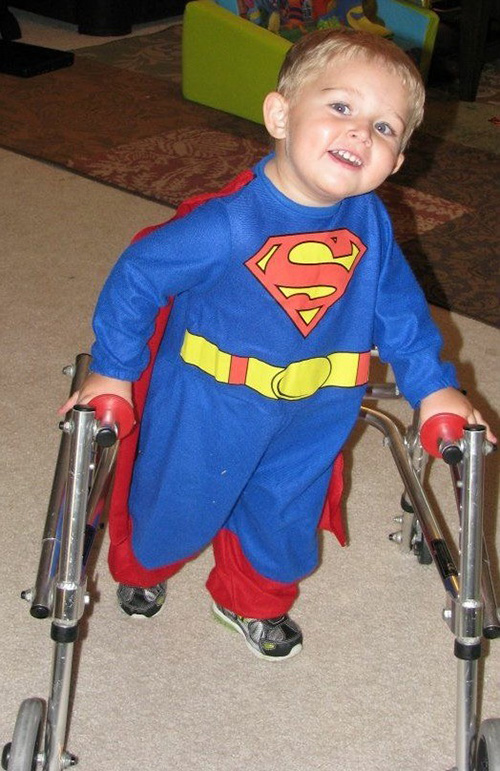
Carter’s condition causes involuntary, irregular movements throughout his body. As a result, nearly everything required extra effort and concentration, even simply walking across a room. He took his first steps at age 3 and relied on a walker for several years afterward. Writing was so difficult he learned to depend on speech-to-text technology because holding a pencil was nearly impossible. His mother and teacher scribe his math work.
Despite these challenges, his parents wanted him to experience childhood fully. He tried piano lessons, swimming, Boy Scouts, and soccer—even if it meant being a step behind or carried down the soccer field.
At age 7, experts diagnosed Carter with benign hereditary chorea after genome mapping revealed a rare deletion of the NKX2-1 gene. The diagnosis brought both fear and relief.
Carter’s mother, Crystal, described those years of waiting as holding her breath. Finally, she said, they could exhale, simply by having a name for what he was facing.
“We know that God has a plan, and there’s a purpose in all this,” Crystal said. “He’s our blessing, and Carter is Carter. Whether we had answers or not, we were always going to keep moving forward.”
Exploring a new possibility
Carter’s pediatric neurologist, Pedro Mancias, MD, who has retired from UT Physicians, referred him at age 8 to Nivedita Thakur, MD, a pediatric movement disorders neurologist at UT Physicians Pediatric Specialists – Texas Medical Center. That referral would prove pivotal.
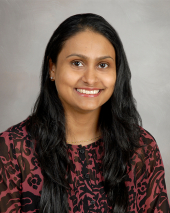
Over the years, Thakur worked to find the right medical management, trying multiple medications and adjusting them as Carter’s needs changed. But as Carter grew older and more aware of his limitations, his frustration also grew.
Still, his mother kept searching for answers. She joined a Facebook group for families worldwide living with the same rare condition, paying close attention to what other patients were trying.
The breakthrough idea came from an unexpected place. Years earlier, she had seen a “60 Minutes” segment about DBS being used to treat Parkinson’s disease. Then someone in the Facebook group mentioned their doctor was considering DBS for their child with benign hereditary chorea.
She quickly reached out to Thakur.
“She didn’t shut me down and said let’s talk about it,” Crystal said.
The conversation opened the door. Thakur connected with colleagues, reviewed the few existing cases, and began carefully evaluating whether Carter could be a candidate.
Choosing deep brain stimulation
Deep brain stimulation delivers electrical impulses to specific areas of the brain to help regulate abnormal movement. The procedure involves implanting electrodes in the brain, connected to a stimulator placed near the collarbone. It’s an established treatment for Parkinson’s disease and some types of dystonia in adults, but it is far less common in children.
“For Carter’s condition, there just aren’t many treatment options,” Thakur said. “We were very cautious.”
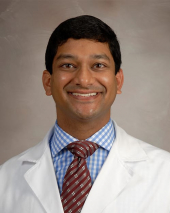
A large multidisciplinary team evaluated Carter’s case, including specialists in neurology, neurosurgery, physical medicine and rehabilitation, neuropsychology, physical and occupational therapy, and social work. Manish N. Shah, MD, a pediatric neurosurgeon at UT Physicians Pediatric Surgery – Texas Medical Center, led the neurosurgical planning.
“Although DBS sounds scary, it is reversible and can significantly help children move more smoothly when done with the right neurologist-neurosurgeon team,” Shah said.
Shah also serves as professor and director of pediatric neurosurgery at McGovern Medical School at UTHealth Houston, John P. and Kathrine G. McGovern Distinguished Chair, THINK Neurology Chair in Pediatric Tumor Research and Innovation, and director of the Pediatric Movement Disorders Center.
Equally important was ensuring Carter, then 16, fully understood what the surgery involved and wanted to proceed. Once he did his own research, Carter became the strongest advocate for moving forward.
Moving ahead with surgery
Before surgery, Shah used high-resolution MRI scans to carefully plan electrode placement, the most delicate part of performing DBS on a child, he said.
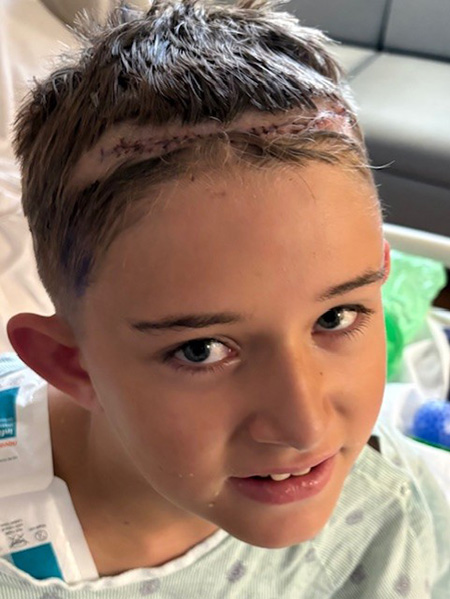
In August 2025, Carter underwent the procedure. In the operating room, the team used intraoperative CT imaging and robotic guidance to precisely place an electrode on each side of his brain.
“There’s very little room for error,” Shah said. “The robot allows us to be precise to within 2 millimeters.”
Next, the electrodes were tunneled from the scalp to the chest and connected to a pulse generator programmed wirelessly through the skin.
“After surgery, the neurologists, led by Dr. Thakur, become the special sauce that program the DBS and make it work its magic,” he said.
As part of standard protocol, Carter’s device remained off for a month to allow his brain to heal. When stimulation began, the team adjusted the settings while Carter repeated phrases and performed simple tasks.
“You could hear the difference in his speech right away,” Crystal said. “You could see how much more fluid he was.”
Surprising results
Given the limited data on DBS in chorea, the team was careful not to overpromise. Still, the results surpassed expectations.
“The degree of improvement has exceeded what we hoped for,” Thakur said. “It’s been life-changing for him.”
Carter’s movements are smoother and more controlled. Eating with utensils is easier. He recently joined his school’s golf team. Carter’s occupational therapist discovered he may be left-handed. Involuntary movements had previously masked it.
His longtime pediatrician, who has known Carter since he was 6 months old, walked into a recent appointment and stopped.
“Wow,” she said. “I’ve never seen his body so still.”
Partnering as a team
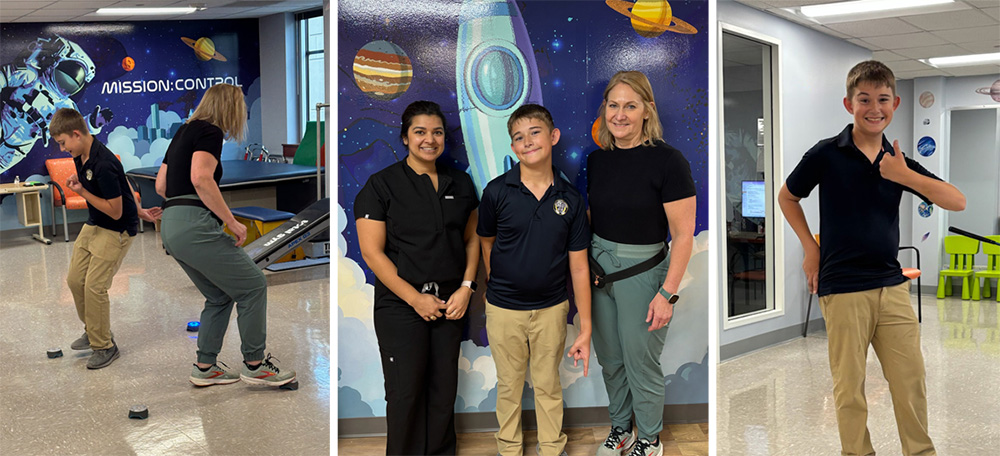
Carter’s care team closely coordinates his DBS programming and therapy at Mission Control Therapy gym to support his progress. He attends weekly sessions with Sara E. McMahan, PT, a physical therapist at UT Physicians Pediatric Specialists – Texas Medical Center, who also works closely with Thakur in clinic. The collaboration allows real-time adjustments to his device based on therapy feedback.
“Most DBS patients work with community therapists,” Thakur said. “Those therapists may not have experience with children who have a deep brain stimulator. Having everything integrated has been invaluable.”
The family also has the ability to adjust Carter’s DBS settings, which Thakur describes as a nice feature for patients.
Improving with physical therapy
Carter began physical therapy in October 2025, after his DBS incisions healed. Before surgery, therapy had been inconsistent because his body and confidence did not align.
“Carter was in a very different place,” McMahan said. “He was anxious and a little resistant to intervention.”
Now, therapy sessions include treadmill work for balance and endurance; core strengthening with weighted balls, planks, and sit-ups; and rhythm and sequencing exercises using interactive lights. Each session ends with a motivating activity designed to build confidence.
Therapy ties closely to Carter’s interests. Since joining the school golf team, he brings his clubs to sessions to work on rotation, coordination, and visual tracking.
“We focus on functional skills he’ll carry into adulthood,” McMahan said. “Once he felt more in control of his body, we could work on more controlled skills, like putting.”
In just six months, the change has been dramatic. Carter progressed from tolerating a minute or two on the treadmill to walking for six minutes, changing speeds, tackling inclines, and even walking backward. He now holds a plank for a full minute and completes 10 sit-ups, starting from zero.
For McMahan, the biggest change isn’t measured in minutes or repetitions, but written all over Carter’s face.
“His self-esteem and feeling that his body is more in control have made such a difference in Carter’s willingness to participate,” McMahan said.
Crystal said the McMahan had to remind her that his body is like a toddler’s.
“Before, it was ‘do the best you can,’” Crystal said. “Now we can actually teach him how to grip, how to move, and how to build skills.”
Crystal said independence is another positive outcome the family experiences in its daily routine. Carter had not been independent with many things, but DBS has allowed that to change.
Providing hope
Thakur believes Carter’s experience offers something rare for other families facing the same diagnosis: real, measurable hope.
Crystal’s advice is simple: “Do your research and know what you’re getting into. It’s a long process, but it’s worth it.”
As for Carter and what he’d tell another child thinking about going through DBS, he didn’t hesitate.
“Go for it,” he said. “It’s worth it.”