
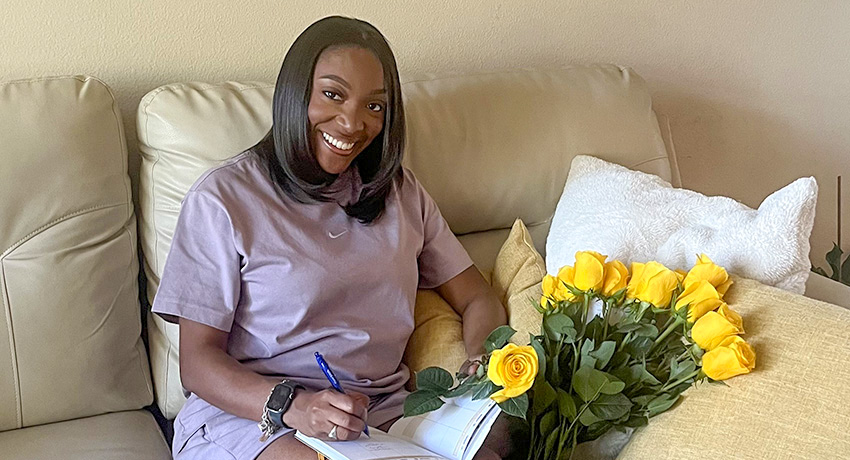
Prestal Malloy, 37, assumed that what she was experiencing was just part of being a woman. Painful periods left her bedridden for days, and severe bloating gave her a pregnant-looking belly. She endured excruciating bowel movements in silence. Through the years, doctors suggested ibuprofen versus a more permanent solution.
“I knew something was wrong, and I wasn’t crazy,” said Prestal, a high school counselor in Pearland. “I think I was patiently waiting for someone to tell me I was right.”
That moment came in summer 2024 — not from a routine visit, but from an ultrasound taken at a fertility clinic, where Prestal was beginning discussions about family planning. The fertility specialist paused at what she saw on the screen and referred her to UT Physicians for additional expertise.
A diagnosis hiding in plain sight
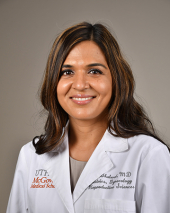
Prestal made an appointment with Asha B. Bhalwal, MD, an OB-GYN specialist at UT Physicians Advanced Minimally Invasive Gynecology (AMIG) – Texas Medical Center. Bhalwal did something no one had done before: she listened.
“No one put the pieces together that Prestal’s symptoms were actually endometriosis,” said Bhalwal, an associate professor in the Department of Obstetrics, Gynecology and Reproductive Sciences and co-director of the AMIGS Fellowship Program at McGovern Medical School at UTHealth Houston.
Endometriosis affects roughly 1 in 10 women of reproductive age, yet it takes an average of 7 to 10 years to diagnose. The condition occurs when tissue similar to the uterine lining grows outside the uterus on the ovaries or fallopian tubes, triggering symptoms such as pain, heavy bleeding, and inflammation. In severe cases, it can damage the bowel and other organs.
For Prestal, it had been closer to 17 years without a diagnosis.
Bhalwal ordered an MRI after her initial exam with Prestal, rather than sending her straight to a diagnostic laparoscopy. This imaging gave the surgical team a clear picture of what they were dealing with before making a single incision. Bhalwal said even a colonoscopy can miss endometriosis if the physician performing it isn’t specifically trained to recognize its subtle presentation. A patient might be told her colonoscopy was totally normal, but still have the disease.
The MRI revealed stage 4 endometriosis, the most severe classification, involving the ovaries, fallopian tubes, and colon. The endometriosis had not just settled on the surface of her bowel but had grown through the wall.
The diagnosis brought mixed emotions for Prestal — relief to finally have answers, but frustration over how long it had taken to reach them. Surgery was the only path forward, but she said hearing Bhalwal’s clear plan helped her move ahead with confidence.
A team approach to a complex surgery
Prestal’s surgery in December 2024 quickly became more complex than anticipated. What was expected to be a two-hour procedure lasted nearly five, as Bhalwal removed endometriosis from more than a dozen sites — all of which tested positive. The disease had so severely altered Prestal’s anatomy that the pelvis had to be reconstructed before removal could even begin.
Bhalwal said outcomes improve most when surgery focuses on removing active endometriosis implants.
“If you don’t remove them, they’ll continue to release inflammatory products, which give you pain,” she said.
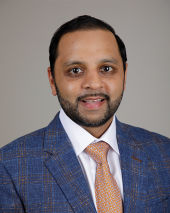
Working alongside her was Amit K. Agarwal, MD, a colon and rectal surgeon at UT Physicians Colon & Rectal Clinic – Sugar Land, who has collaborated with Bhalwal on many similar cases in the last five years.
“Prestal’s case was more complex, because the endometriosis was growing through the entire wall of the colon and rectum,” said Agarwal, an associate professor of surgery at McGovern Medical School. “It’s pretty common to see endometriosis deposits in the pelvis but not advanced through the wall.”
Agarwal performed a low anterior resection, removing a section of the colon and rectum and reconnecting them. This coordinated, multidisciplinary approach with Bhalwal is not optional when the disease is this extensive.
“If you leave any endometriosis behind, they will have recurring symptoms,” Agarwal said. “It’s important to collaborate between colorectal surgery and gynecology so you can clear the endometriosis out of the pelvis and surrounding structures.”
The other side of surgery
Prestal spent three days in the hospital before going home to recover during her school district’s winter holiday break. The recovery was harder than she anticipated. She had run half marathons in the past but getting out of bed required core strength she didn’t realize.
Within four to six months, Prestal experienced a pain-free period and no cramping, something she doesn’t remember before. The pain level was around 2, on a scale of 1 to 10. Before, it was excruciating at a 12.
“I felt so much relief,” Prestal said. “Like I got my life back and had more hope.”
Prestal said people understand cancer and diabetes, but endometriosis just feels fake, because no one can see it. What mattered most was finally having a physician who truly listened — not only to what she said, but to what she struggled to put into words. Bhalwal was touched by how Prestal felt disregarded.
“When you hear another woman say she was suffering and nobody would listen, it’s hard not to be moved by that,” Bhalwal said. “Helping her get a better quality of life was important to me.”
Endometriosis didn’t end my story. It just forced me to rewrite it.
— Prestal Malloy, pregnant at age 37

Focusing on hope
During her endometriosis, Prestal journaled daily and attended therapy sessions to talk through the journey. She read a lot about the diagnosis after surgery and focused on reading inspirational books to maintain hope for fertility. Once she was cleared by Bhalwal, Prestal started walking about 30 minutes each evening in her neighborhood, which was a big change for her.
“I was used to running half marathons and being proud of my body and fitness,” she said. “I felt a bit behind, but I learned this was just a new stage of life that required me to slow down, and that is OK.”
A positive pregnancy
Prestal returned to her fertility team and succeeded with IVF. She is now pregnant with an August 2026 due date, at age 37.
“I’m so happy, and I want women to know that it’s possible,” Prestal said. “I’ve always had a bit of faith that it’s God’s timing but also left a healthy amount of skepticism on the table.”
Prestal said Bhalwal described her endometriosis as a “little roadblock” as they prepared to have a family and never said no. She also offered compassion when her mom was in hospice and not getting better.
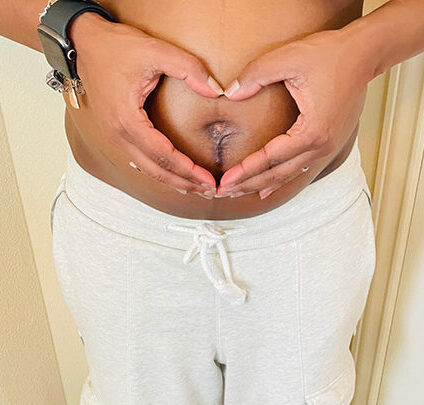
Bhalwal hopes Prestal’s journey reaches women who are still waiting for someone to take them seriously.
“I appreciated how she just stopped and said how sorry she was,” Prestal said. “Having people on your care team like that makes a world of difference.”
“Patients need to hear that — yes, you can have a quality of life, you can have a pregnancy. A hysterectomy is not the only option when you’re suffering,” Bhalwal said.
Prestal’s advice is simple: trust yourself and say something.
“Without this surgery, I don’t think the pregnancy would have been successful,” Prestal said. “Dr. Bhalwal removed that barrier for me and made it possible for us to have a baby.”