


Dawn Cardinal is busy. The new mom is finding the balance between late nights and early mornings, a slew of doctors’ appointments, and the piles of dirty laundry that come with motherhood—her dream come true.
“I’ve always wanted to be a mother,” Dawn said. “Right now, I feel so accomplished.”
Even with the unorganized, hectic, and never-ending tasks that come with parenthood, Dawn is at peace. She glows with a sense of euphoria and calm that comes only with the defeat of a painful, exhausting, and heartbreaking journey. A journey that kept motherhood at an unreachable distance, filling her with doubt and despair.
The emotional toll of repeated miscarriages
In 2021, Dawn was 16 weeks pregnant when severe pain sent her to the emergency room. She was in labor. It was her second time holding a pregnancy into the second trimester, only to lose it. The loss marked her sixth miscarriage. The sense of failure was overwhelming.

“I was so distraught afterward, I didn’t think I could leave the hospital,” Dawn said.
She was sad, angry, frustrated, and confused. Sitting in her hospital bed, unsure how to find the courage to leave the labor and delivery unit without a baby to hold, she found comfort in a visit from Sean C. Blackwell, MD, a maternal-fetal medicine specialist with UT Physicians Maternal-Fetal Medicine Center – Texas Medical Center.
“Recurrent miscarriage is scary, anxiety-triggering, and sad. Nobody’s done anything wrong, and when I visit families going through this, I’m there to offer help,” said Blackwell, who is Memorial Hermann Chair and the Emma Sue Hightower Development Board Professor in Obstetrics, Gynecology and Reproductive Sciences at McGovern Medical School at UTHealth Houston.
“It was my first time meeting him. He came in to talk to me, and showed me so much kindness, and it’s something I will never forget,” Dawn said. “He told me to call him when I was ready to try again.”
Finding answers
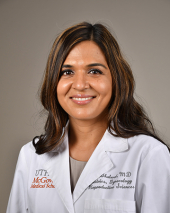
Dawn followed up, and Blackwell referred her to Asha Bhalwal, MD, an OB-GYN specialist at UT Physicians Advanced Minimally Invasive Gynecology (AMIG) – Texas Medical Center.
“Even from the first visit, Dr. Bhalwal took the time to care for me,” Dawn said. “She wanted to understand my health history and truly search for the cause of my miscarriages.”
Following a thorough round of testing, which included lab work and an MRI, Bhalwal determined Dawn had cervical insufficiency and adenomyosis. The coexistence of these conditions further complicated her reproductive and obstetric management, requiring a highly individualized approach to care.
“This is the complete care we strive to provide. These are separate conditions, and identifying both was important to tailor her follow-up care,” said Bhalwal, an associate professor in the Department of Obstetrics, Gynecology and Reproductive Sciences and co-director of the Fellowship in Advanced Minimally Invasive Gynecology at McGovern Medical School at UTHealth Houston.
Adenomyosis diagnosis
Adenomyosis occurs when tissue from the lining of the uterus grows into the uterine wall. It can cause the uterus to double or triple in size and cause heavy, abnormal menstrual bleeding. Adenomyosis is a rare condition with no known cause.
“Adenomyosis is associated with an increased risk of miscarriage and not being able to get pregnant,” Bhalwal explained.
Treatment for adenomyosis
There are several treatment options for adenomyosis, from medication management to surgical procedures. Because her symptoms were manageable and her goal was a healthy pregnancy, Dawn chose close monitoring and conservative management with medication.
Cervical insufficiency diagnosis
Cervical insufficiency means difficulty holding on to pregnancy and is typically diagnosed after several miscarriages in the second trimester.
“The mother will typically end up in the hospital because of bleeding and then learn their cervix dilated without much pain, and by this time, the pregnancy is lost,” Bhalwal said.
Treatment for cervical insufficiency
There are several treatment options for cervical insufficiency, and the best approach depends on the patient’s pregnancy history, prior preterm births or losses, and cervical length measurement. Following a multidisciplinary collaboration with Blackwell, a cervical cerclage was recommended for Dawn.
What is a cervical cerclage?
A cervical cerclage is a stitch placed around the cervix to reinforce it and keep it closed during pregnancy.
There are two types of cervical cerclage:
- Vaginal cerclage: Completed during the second trimester or later, this is a temporary stitch removed before birth.
- Transabdominal cerclage: Completed before pregnancy or between 10 and 23 weeks of pregnancy, this is a permanent stitch and requires cesarean section for delivery.
Due to her history of pregnancy loss, Dawn met the criteria for a transabdominal cerclage.
“Transabdominal cerclage is a procedure that helps women who have recurrent pregnancy loss in the second trimester when their cervix is not holding the pregnancy,” Blackwell explained.
“Dawn wanted an intervention with the highest success rate, and she chose transabdominal cerclage,” Bhalwal said.
Surgery for transabdominal cerclage
The surgery for a transabdominal cerclage is an outpatient procedure that takes about 1 to 2 hours.
Bhalwal used a minimally invasive technique through three small incisions, one inside the belly button and one on either side. The cerclage stitch was placed at the junction between the cervix and uterus.
Recovery from the surgery required pain medication for 3 to 4 days. Dawn took 2 weeks off work and was back to full activity at 4 weeks post-surgery.

Healthy pregnancy after miscarriage
Within 9 months of the transabdominal cerclage procedure, Dawn was pregnant, and for the first time, she was able to carry the pregnancy through the second and third trimesters.
Her daughter, Iris, was delivered through a C-section at 37 weeks and 3 days.
“She’s perfect,” Dawn said through a smile. “I love motherhood.”
The kindness factor
Dawn credits the team at UT Physicians for helping her and her husband become parents.
“They treated me like they’d known me my whole life,” Dawn said. “Dr. Blackwell and Dr. Bhalwal helped me overcome so much adversity, and they made me a mother. UT Physicians feels like home for us.”
From emotional support to medical answers, treatment, and care, each patient’s journey is unique. Through personalized diagnostics and treatment plans, the whole patient is cared for with individualized attention.
“As high-risk doctors, we spend a lot of time with loss, and successful outcomes like Dawn’s are why we do this,” Blackwell said.
“These doctors are the best of the best, and they really do care,” Dawn said.